Showing posts with label red-eyed vireo. Show all posts

Friday, September 16, 2016

Feature: Sawgrass Lake Park Pt. I

It required a single visit to Sawgrass Lake Park in Pinellas County to consider it one of my favorite wildlife venues in Florida.


The Anhinga above (image 1) was photographed at Sawgrass Lake Park in September 2016.

Sawgrass Lake Park, north of downtown St. Petersburg and southwest of Tampa, was created primarily to manage stormwater flooding in the adjacent city of Pinellas Park. A small waterfall in fact could be seen flowing into Sawgrass Lake while looking in the direction of Pinellas Park from the lake's observation tower.


The Blackburnian Warbler with prey above (image 2) was photographed at Sawgrass Lake Park in September 2016.


The juvenile Red-bellied Woodpecker above (image 3) was photographed at Sawgrass Lake Park in September 2016.


The Common Grackle above (image 4) was photographed at Sawgrass Lake Park in September 2016.

This park was not originally on my radar in early planning for a Fall migration trip from Fort Myers with birding bud, Tom Obrock. The initial thought was to make a trip to Miami's A. D. Barnes Park with unfavorable weather persistent, and then Fort De Soto Park considered with hopes of seeing migrating birds.


The Blackburnian Warbler above (image 5) was photographed at Sawgrass Lake Park in September 2016.


The Blackburnian Warbler above (image 6) was photographed at Sawgrass Lake Park in September 2016.


The Prairie Warbler above (image 7) was photographed at Sawgrass Lake Park in September 2016.

Trumpeter Swan, reported earlier at Eagle Lake Park immediately southeast of Clearwater, was on my mind when deciding at the last minute to make Sawgrass Lake Park the primary destination with its potential for something unusual. Hurricane Hermine had made impressive checklists at Sawgrass Lake Park in the days preceding our visit.


The Prairie Warbler above (image 8) was photographed at Sawgrass Lake Park in September 2016.


The Prairie Warbler above (image 9) was photographed at Sawgrass Lake Park in September 2016.


The Northern Parula above (image 10) was photographed at Sawgrass Lake Park in September 2016.

It required a 5:00am departure from Fort Myers for Tom and I to arrive at the park shortly after sunrise. The traffic on I-75 seemed unusually heavy to me on this 6 September journey. Shortly before arriving at the park we approached what could have become a catastrophic accident on the interstate. I will be getting a dashcam soon.


The Black-and-white Warbler above (image 11) was photographed at Sawgrass Lake Park in September 2016.


The Yellow Warbler above (image 12) was photographed at Sawgrass Lake Park in September 2016.


The Northern Parula with prey above (image 13) was photographed at Sawgrass Lake Park in September 2016.

There were already a few cars parked at the visitor's facilities when we arrived. I noticed that a couple of people with binoculars and cameras were walking back toward the entrance to the park. They obviously knew something that we didn't.


The Northern Parula with prey above (image 14) was photographed at Sawgrass Lake Park in September 2016.


The Northern Parula above (image 15) was photographed at Sawgrass Lake Park in September 2016.


The Tufted Titmouse above (image 16) was photographed at Sawgrass Lake Park in September 2016.

Tom and I opted to traverse the boardwalk that meanders into the Red Maple swamp first. We soon found that the Maple Trail portion of the boardwalk was closed perhaps due to storm damage from Hurricane Hermine. A park worker advised that entering the closed area would result in a one year banishment from the park if caught.


The Worm-eating Warbler above (image 17) was photographed at Sawgrass Lake Park in September 2016.


The Worm-eating Warbler above (image 18) was photographed at Sawgrass Lake Park in September 2016.


The Yellow-throated Warbler above (image 19) was photographed at Sawgrass Lake Park in September 2016.

Shortly after passing the intersection of the Sawgrass and Maple Trails we encountered birds. Mainly Blackburnian Warbler which was a life bird for me. A Golden Silk Orb-weaver was motionless in its web in this area as well.


The Yellow-throated Warbler above (image 20) was photographed at Sawgrass Lake Park in September 2016.


The Yellow-throated Warbler above (image 21) was photographed at Sawgrass Lake Park in September 2016.


The Yellow-throated Warbler above (image 22) was photographed at Sawgrass Lake Park in September 2016.

Continuing on to the observation tower resulted in an unexpectedly quiet walk. There was also a near complete absence of birds flying over the lake although many waders could be seen foraging on the far side with a pair of Red-shouldered Hawks perched on a distant fence. A scope would have been useful here.


The Yellow-throated Warbler above (image 23) was photographed at Sawgrass Lake Park in September 2016.


The Hooded Warbler above (image 24) was photographed at Sawgrass Lake Park in September 2016.


The Red-eyed Vireo above (image 25) was photographed at Sawgrass Lake Park in September 2016.

Please be sure to be reminded about this weekly Southwest Florida Wildlife Blog with the email gadget located at the top of the page.


The Summer Tanager above (image 26) was photographed at Sawgrass Lake Park in September 2016.

Please also see Feature: Sawgrass Lake Park Part II

Friday, April 29, 2016

Fort De Soto Park Spring Migration: Pt I

A trek to Fort De Soto Park in Pinellas County is especially rewarding during migration season.


The Common Loon above (image 1) was photographed at Fort De Soto Park in April 2016.

Fort De Soto is a magnet for birds. In fact there have been 337 species sighted at the park and reported to eBird as of this writing. Ron Smith has noted that a Western Grebe was observed and photographed by Marvin Waas in late 1954 which was the first and last time the species was seen in Pinellas County. This sighting occurred about eight years before Fort De Soto Park opened to the public.


The sunrise above (image 2) was photographed at Fort De Soto Park in April 2016.


The Brown-headed Cowbird above (image 3) was photographed at Fort De Soto Park in April 2016.


The Short-billed Dowitcher above (image 4) was photographed at Fort De Soto Park in April 2016.


The Least Sandpiper above (image 5) was photographed at Fort De Soto Park in April 2016.


The Willet above (image 6) was photographed at Fort De Soto Park in April 2016.


The Willet above (image 7) was photographed at Fort De Soto Park in April 2016.


The Willet above (image 8) was photographed at Fort De Soto Park in April 2016.


The Piping Plover above (image 9) was photographed at Fort De Soto Park in April 2016.


The Dunlin above (image 10) was photographed at Fort De Soto Park in April 2016.

Tom Obrock and I made a mid April journey to Fort De Soto Park to enjoy the semi-annual migratory spectacle. We had discussed alternate venues to visit in the event Fort De Soto was quiet, but they were not necessary as there was good bird activity resulting in a full day's effort (including the four hour commute).


The Semipalmated Plover with Piping Plover above (image 11) was photographed at Fort De Soto Park in April 2016.


The Semipalmated Plover above (image 12) was photographed at Fort De Soto Park in April 2016.


The Black-bellied Plover above (image 13) was photographed at Fort De Soto Park in April 2016.


The Forster's Tern above (image 14) was photographed at Fort De Soto Park in April 2016.


The Forster's Tern above (image 15) was photographed at Fort De Soto Park in April 2016.


The Nanday Parakeet above (image 16) was photographed at Fort De Soto Park in April 2016.


The Nanday Parakeet above (image 17) was photographed at Fort De Soto Park in April 2016.


The Nanday Parakeet above (image 18) was photographed at Fort De Soto Park in April 2016.


The Nanday Parakeet above (image 19) was photographed at Fort De Soto Park in April 2016.

At the East Beach Turnaround there was some entertaining action as a pair of Willet seemed to be at odds with one another while a Piping Plover showed dominance over a Semipalmated Plover. While about a dozen Nanday Parakeet were observed at the entrance to the park, they would later congregate into a flock of 30 at East Beach. It was interesting to observe European Starling showing dominance over Nanday Parakeet here.


The Nanday Parakeet above (image 20) was photographed at Fort De Soto Park in April 2016.


The European Starling with Nanday Parakeet above (image 21) was photographed at Fort De Soto Park in April 2016.


The European Starling with Nanday Parakeet above (image 22) was photographed at Fort De Soto Park in April 2016.


The Nanday Parakeet above (image 23) was photographed at Fort De Soto Park in April 2016.


The Nanday Parakeet above (image 24) was photographed at Fort De Soto Park in April 2016.


The Nanday Parakeet above (image 25) was photographed at Fort De Soto Park in April 2016.


The Nanday Parakeet above (image 26) was photographed at Fort De Soto Park in April 2016.


The Nanday Parakeet above (image 27) was photographed at Fort De Soto Park in April 2016.


The Nanday Parakeet above (image 28) was photographed at Fort De Soto Park in April 2016.

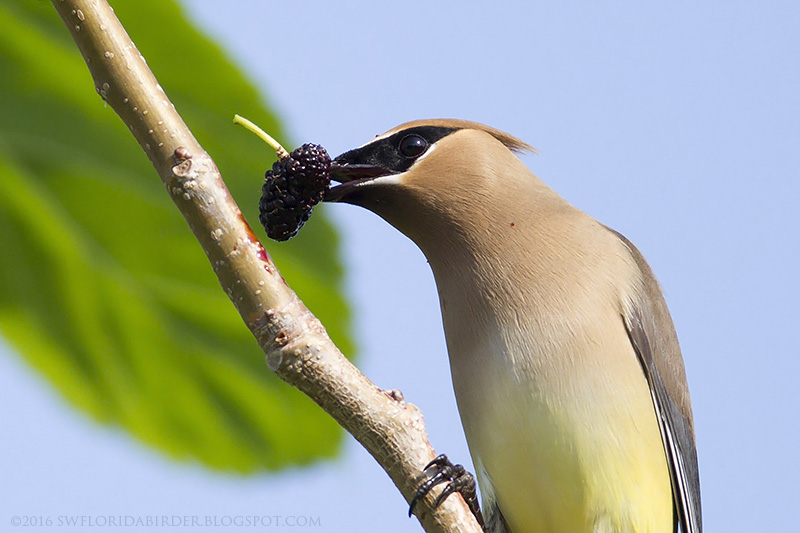
A large flock of Cedar Waxwing was also active at mid-morning near the Bay Pier. They were making very quick work of the Mulberries that were in various stages of ripeness. A few warblers species were observed along the southern end of Mullet Key with a lone Hooded Warbler making a very brief appearance.


The Fish Crow above (image 29) was photographed at Fort De Soto Park in April 2016.


The Black-and-white Warbler above (image 30) was photographed at Fort De Soto Park in April 2016.


The Summer Tanager above (image 31) was photographed at Fort De Soto Park in April 2016.


The Cedar Waxwing above (image 32) was photographed at Fort De Soto Park in April 2016.


The Cedar Waxwing above (image 33) was photographed at Fort De Soto Park in April 2016.

Always reluctant to leave a productive area, our next stop at Fort De Soto Park would be North Beach.


The Cedar Waxwing above (image 34) was photographed at Fort De Soto Park in April 2016.


The Red-eyed Vireo above (image 35) was photographed at Fort De Soto Park in April 2016.

Please be sure to be reminded about this weekly Southwest Florida Wildlife Blog with the email gadget located at the top of the page.


The Red-eyed Vireo above (image 36) was photographed at Fort De Soto Park in April 2016.

Please also see Fort De Soto Spring Migration: Part II