Rachael Baker above was photographed at Bunche Beach Preserve in November 2011.
A visit to Bunche Beach Preserve that I had expected to mention in last week's post is mentioned here due to prior time constraints.
With Chris and Rachael Baker back in the area vacationing from the United Kingdom, we made another early morning visit to Bunche toward the end of November.
 The Reddish Egret above was photographed at Bunche Beach Preserve in November 2011.
The weather was great while the birds were initially distant as the tide was very low.
As the tide came in, the birds were forced to get closer and closer to us.
 The Marbled Godwit above was photographed at Bunche Beach Preserve in November 2011.
The highlight here was the photography of primarily the flight of Marbled Godwit.
It was a treat to again see American Birding Association member Hemant Kishan visiting from Michigan.
 The Marbled Godwit above was photographed at Bunche Beach Preserve in November 2011.
At one point there was interest in a plover that was thought to possibly be American Golden Plover.
Hemant initially notified me of his doubt that the bird seen was golden after looking at his images closely.
 The Black-bellied Plover above was photographed at Bunche Beach Preserve in November 2011.
I was able to get confirmation from local naturalist extraordinaire Vince McGrath, whom had seen the American Golden Plover at Bunche in October 2011, that the bird photographed was indeed Black-bellied Plover.
Chris asked me if I was sure I was photographing the right bird which I believe I was.
 The American White Pelican above was photographed at Bunche Beach Preserve in November 2011.
While these bird species can appear quite similar, I learned that the best way to distinguish them is that the golden lacks the black coloration on its axillaries (in non-breeding plumage) when the bird is observed in flight.
I next met up with Chris and Rachael at Eagle Lakes Park in Naples for sunrise.
 The Dunlin above was photographed at Bunche Beach Preserve in November 2011.
A couple of joggers were flushing the birds early with most of the birds likely on the move at first light nonetheless.
It was good to see that the vegetation was maintained around the gazebo unlike on a visit last year.
 Chris Baker above was photographed at Eagle Lakes Park in December 2011.
Red-shouldered Hawk is very reliably seen at this venue and was perched briefly on an a cypress tree as the hundreds of wading birds left their roosts to feed elsewhere.
After arriving at Sugden Regional Park, a few miles west on Highway 41, Chris made the comment that a woodpecker was not seen for the first time in many years visiting the park.
 The Red-shouldered Hawk above was photographed at Eagle Lakes Park in December 2011.
Pied-billed Grebe, Double-crested Cormorant, Tricolored Heron, Snowy Egret, Blue-gray Gnatcatcher, Yellow-rumped Warbler, and Muskovy Duck were otherwise all seen at very close range.
Chris, Rachael and I then traveled south to meet up at Tigertail Beach Lagoon.
 The Snowy Egret above was photographed at Sugden Regional Park in December 2011.
Chris had told me of the great time he had days earlier with the herons walking right up to him as Florida's birds are want to do.
Another highlight for him on that trip was Lesser Yellowlegs observed loafing at very close range.
 The Blue-gray Gnatcatcher above was photographed at Sugden Regional Park in December 2011.
While Rachael stayed near the Osprey nest, Chris and I noted the tide lower than either of us had observed in the Lagoon before.
The shore and wading birds were as such spread out over a very large area.
 The Yellow-rumped Warbler above was photographed at Sugden Regional Park in December 2011.
The water was never more than a foot deep, yet one needs to be advised that the sea grasses are very slippery in spots when walking in the Lagoon.
I primarily focused my attention on Short-billed Dowitcher that chose to circle around me as they foraged.
 The banded Piping Plover above was photographed at Tigertail Beach Lagoon in December 2011.
The Osprey were observed to be nest building with a flip flop part of its construction.
On the way back to Fort Myers I stopped in at Ritz Camera in Naples with hopes of finding a replacement tripod only to find a disappointing selection.
 The Little Blue Heron above was photographed at Tigertail Beach Lagoon in December 2011.
To end the day, I again met up with Chris and Rachael at Bunche Beach Preserve to take advantage of the remarkable light from the waning sun.
Local wildlife observer and photographer Gail Campbell was met on the beach.
 The Short-billed Dowitcher above was photographed at Tigertail Beach Lagoon in December 2011.
American Avocet failed to make an appearance during the visit expecting it in the afternoon while Chris noted he observed the species in the morning earlier in the week.
A pair of nemesis bird species that I had not photographed until this week are courtesy of the guidance of Tom Obrock.
 The Short-billed Dowitcher above was photographed at Bunche Beach Preserve in December 2011.
I had mentioned to Tom a while back that I had not yet seen the Florida Scrub-Jay, let alone photograph it.
While I hadn't made a diligent effort to find the scrub-jay until now, its preferred habitat is unquestionably confined to limited areas.
 The Marbled Godwit above was photographed at Bunche Beach Preserve in December 2011.
It was here in rural northern Cape Coral that Chris, Rachael, Branyo Kuvik visiting from Slovakia, and I hunkered down to observe the magnificent wildlife.
Branyo had joined us at the Cape Coral Library unexpectedly as we were all scouting for Burrowing Owl.
 The Florida Scrub-Jay above was photographed in rural Cape Coral in December 2011.
At Tom's (visiting Harns Marsh Preserve this day) Cape Coral stomping grounds, we spent the majority of our time at a pair of Burrowing Owl nests where the incredibly cute birds especially in their behavior were observed.
When not looking cute, a Burrowing Owl has an expression of knock down, drag out, do not mess with me.
 The Burrowing Owl above was photographed in rural Cape Coral in December 2011.
Branyo had the interesting idea to place a branch on his tripod that allowed the birds to perch with a natural view for photography as opposed to the birds flying through resting on the PVC pipes marking the owl nests.
The Florida Scrub-Jay amazingly to me readily perched on Branyo's branch almost immediately.
 The Florida Scrub-Jay above was photographed in rural Cape Coral in December 2011.
I had the idea to place branches in the PVC pipes which would prove fortuitous as well.
A pair of owls would make occasional flights between two nests that are possibly interconnected via a tunnel.
 The Burrowing Owl above was photographed in rural Cape Coral in December 2011.
We also had sighting of Loggerhead Shrike, a target species for Chris, before Branyo unfortunately had to leave.
A short while later, a couple of flocks of Monk Parakeet made their way through offering a photographic opportunity although the birds were seen well over a hundred yards distance.
 The Monk Parakeet above was photographed in rural Cape Coral in December 2011.
An equal thrill for me with sighting and photography of the Florida Scrub-Jay were the images I was able to capture for the first time of Red-tailed Hawk.
I had only seen this species once before at STA5 while unable to photograph the bird.
 The Red-tailed Hawk above was photographed in rural Cape Coral in December 2011.
From Cape Coral we headed to Sarasota County to visit Pinelands Reserve, or more specifically "the dump" off Exit 195 along Interstate 75, that had been brought to Chris's attention by wildlife photographer Bob Blanchard whom Chris had met at Harns Marsh Preserve earlier in the week.
Although the landfill at Pinelands Reserve has prison type fencing along its perimeter, the venue still offers a wonderful wildlife experience.
 The Sandhill Crane above was photographed at Pinelands Reserve in December 2011.
Four resident Sandhill Crane were observed while the vultures seemed to remain near directly over the landfill itself.
Bald Eagles were observed in the company of the greatest concentration of American Kestrels I've seen anywhere visited thus far.
 The Bald Eagle above was photographed at Pinelands Reserve in December 2011.
Additional species seen include Eastern Phoebe, Tree Swallow, European Starling, American Crow, Fish Crow, Mourning Dove, Cattle Egret, Common Grackle, Savannah Sparrow, Turkey Vulture, Black Vulture, Laughing Gull, Belted Kingfisher, Great Egret, Anhinga, and an unidentified nor photographed warbler that had an olive green back and pale yellow belly.
I was quite surprised to observe at one point a Tree Swallow chasing one of the kestrels.
 The American Kestrel above was photographed at Pinelands Reserve in December 2011.
After a fairly brief visit to the landfill we headed to Venice Rookery to end the day.
I was especially curious to see how the venue looked with the removal of a lot of the vegetation around the pond.
 The Great Blue Heron above was photographed at Venice Rookery in December 2011.
I was disappointed from a photographer's point of view, but there is certainly the advantage now of being able to observe the roosting birds from virtually any angle.
Great Blue Heron were initially observed roosting on the small island which offers protection from predators by the pond.
 The Anhinga above was photographed at Venice Rookery in December 2011.
Double-crested Cormorant were observed to be successfully feeding on good sized fish.
An Osprey seemed to keep watch from above with its nest seen on a communication tower nearby.
 The Great Blue Heron above was photographed at Venice Rookery in December 2011.
Four Mottled Duck made a brief flyover to the northeast while night-herons were not seen.
As the sun began to set, the island was occupied by the arrival of several more Great Blue Heron and countless other birds including Great Egret, Cattle Egret, Snowy Egret, White Ibis, Anhinga, Glossy Ibis, Little Blue Heron, and Tricolored Heron.
 The Cattle Egret above was photographed at Venice Rookery in December 2011.
The resident alligator seemed very patiently waiting for the 2012 nesting season's hatchlings that will fall out of their nests in the months ahead.
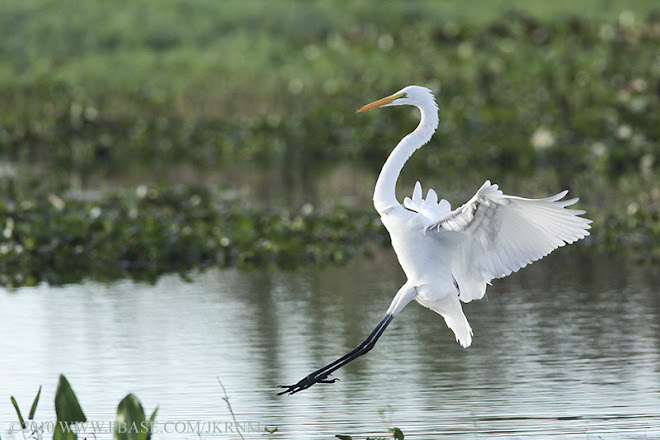
Although Chris has repeatedly told me that Rachael is not a full fledged birder, I have found her to be wonderfully helpful in alerting us to the wildlife.
 The alligator above was photographed at Venice Rookery in December 2011.