
I had been giving a lot of thought this past month to revisiting the Bald Eagle nest south of Fort Myers Beach at Big Carlos Pass.
 The sunrise above was photographed at Lovers Key State Park in November 2011.
A primary goal in my wildlife observations to close out the year is to capture the mating behavior of the raptor.
I'm well aware of the fact that this may require countless hours of observation and will certainly have a tremendous amount of luck if I'm successful.
 The Mangrove Skipper above was photographed at Lovers Key State Park at Big Carlos Pass in November 2011.
Comfortable conditions with an unobstructed sunrise were welcome during my first chance to make my observations this week.
A bird call that I was unsure of was heard upon my arrival at Lovers Key State Park.
 The Obscure Skipper above was photographed at Lovers Key State Park at Big Carlos Pass in November 2011.
The mosquitoes that have been reported to be at their worst in 20 years with heavy rains in October were virtually absent while sand gnats were aggressive early in the day.
My approach to the eagle nest allowed observation of a bird in the nest with the bird's mate in a nearby tree.
 The Gulf Fritillary above was photographed at Lovers Key State Park at Big Carlos Pass in November 2011.
Both birds took flight upon my first glimpse of them.
The eagles were heard occasionally from different directions in the next few hours as I waited for their return to view.
 The Belted Kingfisher above was photographed at Lovers Key State Park at Big Carlos Pass in November 2011.
It's my expectation to find that these are the same Bald Eagles that I observed at the nest earlier this year.
I'll be assured when I note the band on one of the legs of the birds.
 The scene above was photographed at Fort Myers Beach in November 2011.
Gloria Beauchamp, park manager at Lovers Key, has noted that the Bald Eagle has been seen in all areas of the Park.
At one point I thought I had observed a woodpecker I had not seen before, but it turned out to be a Belted Kingfisher after close inspection of its image on the computer.
 The scene above was photographed at Fort Myers Beach in November 2011.
Blue-gray Gnatcatchers were the most abundant species seen with one individual working its way through a shrub merely a few feet away allowing a remarkable view of the diminutive bird.
Insect life was prolific as well with bees particularly active around me.
 The scene above was photographed at Fort Myers Beach in November 2011.
I would again make an identification request of Vince Lucas to help confirm a species seen.
He guided me in the right direction while concluding the creature to be an Obscure Skipper after making comparisons with Brian Ahern's imagery.
 The scene above was photographed at Fort Myers Beach in November 2011.
Particularly vocal later in the morning during my observations were kingfishers and Ospreys.
The guttural calls of White Ibis were heard as they fed in one of the park's inner waterways though were obscured from view by the thick mangrove trees.
 The scene above was photographed at Fort Myers Beach in November 2011.
Heading home I stopped at Fort Myers Beach to see the sand sculptures built during the 25th Annual American SandSculpting Championship Festival held behind the GullWing Resort.
Also celebrating its 25th anniversary is the World Championship of Sand Sculpting that will be held November 17-27, 2011 behind the Holiday Inn at Fort Myers Beach.
 The scene above was photographed at Fort Myers Beach in November 2011.
The sand sculptures seen created at the American event were very impressive days after the sculptures were created.
They still attracted many visitors on the day of my visit while it is believed that 50,000 people attended the event the week before.
 The scene above was photographed at Fort Myers Beach in November 2011.
The sculptures were very diverse in their themes and of many varying sizes with a few dwarfing those admiring them.
The space limitations here regrettably only offers a small representation of what was seen with a photo gallery on this subject created as time permits.
 The scene above was photographed at Fort Myers Beach in November 2011.
If I'm fortunate enough to view the creations at the World Championship, it will be many months before I complete such an endeavor.
Day 2:
 The Bald Eagle above was photographed at Lovers Key State Park at Big Carlos Pass in November 2011.
The morning of my trip back to attempt to observe the Bald Eagles at Lovers Key was met with a rare opportunity to observe a near full moonset in nighttime conditions.
I've only had this experience once before and have great regret for missing the chance to photograph the moon dipping below the horizon.
 The Red-bellied Woodpecker above was photographed at Lovers Key State Park at Big Carlos Pass in November 2011.
On the previous occasion, I'm quite sure I was making a trip to observe the eagles.
The sounds heard at the parking area were not repeated on this day discounting further investigation.
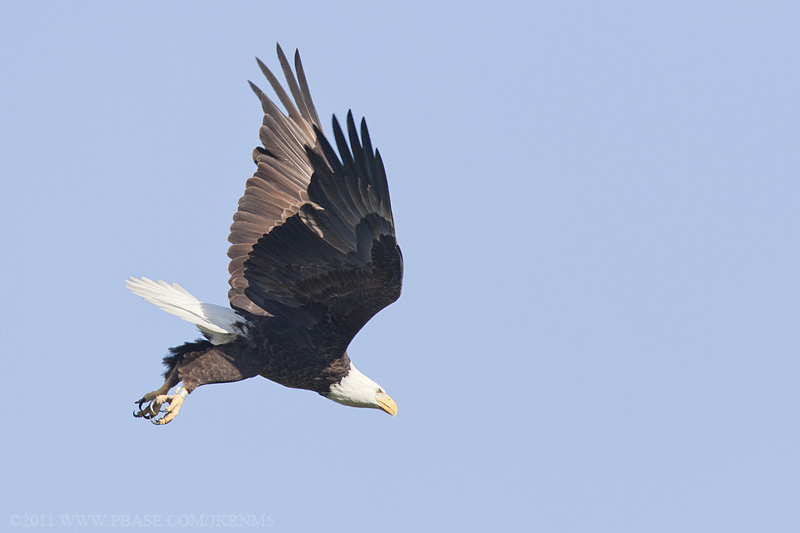 The Bald Eagle above was photographed at Lovers Key State Park at Big Carlos Pass in November 2011.
Arrival near the Bald Eagle nest was fortuitous as the birds seemed to remember me and remained in view.
Woodpeckers were much more prevalent this day with three species seen including Red-bellied, Downy and Pileated.
 The Pileated Woodpecker above was photographed at Lovers Key State Park at Big Carlos Pass in November 2011.
The Pileated Woodpecker, significantly larger than the other woodpeckers, allowed the most interesting audible treat with its distinctive drumming created on the trees.
I was offered many more species of bird passing through on this day while a few others were absent.
 The Downy Woodpecker above was photographed at Lovers Key State Park at Big Carlos Pass in November 2011.
Such is the case with wildlife observation while we can occasionally take advantage of reports of species for up to weeks at a time in search of a rarity.
I caught a glimpse of what I immediately recognized as flycatcher and would compare my recollection of it to the only image I've captured of Great Crested Flycatcher nearly four years earlier at the same wildlife venue.
 The Bald Eagle above was photographed at Lovers Key State Park at Big Carlos Pass in November 2011.
Northern Mockingbird, Florida's state bird, was observed among Blue Jays.
Blue-headed Vireo was a welcome sight as it made its way through as well.
 The Blue Jay above was photographed at Lovers Key State Park at Big Carlos Pass in November 2011.
A brief contentious exchange between one of the Bald Eagles and an Osprey was observed with the Osprey the aggressor.
As Bald Eagles will mate for life, the pair I observed seemed to offer a reaffirmation this day as they were particularly engaging with each other on a few occasions.
 The Bald Eagle above was photographed at Lovers Key State Park at Big Carlos Pass in November 2011.
Several images taken of one of the eagles shows evidence of a metal band which has me assured that these are the same birds I've been observing.
The band was otherwise difficult to distinguish with it obscured by some of the eagle's 7192 feathers.
 The Bald Eagle above was photographed at Lovers Key State Park at Big Carlos Pass in November 2011.
Both birds were seen in the nest at one point with what appeared a food item possibly from the day before.
One of the birds was also observed to be meticulously moving part of the nest material with great care.
 The Bald Eagle above was photographed at Lovers Key State Park at Big Carlos Pass in November 2011.
The 2012 nesting season looks promising.


