A visiting birder and author from Ferguson, Missouri named Cornelius "Connie" Alwood was the first to report an American Flamingo to eBird that has favored Bunche Beach Preserve this past week in Fort Myers, Florida.
The American Flamingo above (image 1) was photographed at Bunche Beach Preserve in January 2016.
Among Connie's other eBird reports of interest include a mid July 2015 nocturnal observation at Columbia Bottom Conservation Area at the confluence of the Missouri and Mississippi Rivers where he noted a half dozen Mississippi Kites soaring out of sight, as well as a late November 2015 report from California Gulch, Arizona where he and a bird guide observed a Black-capped Gnatcatcher.
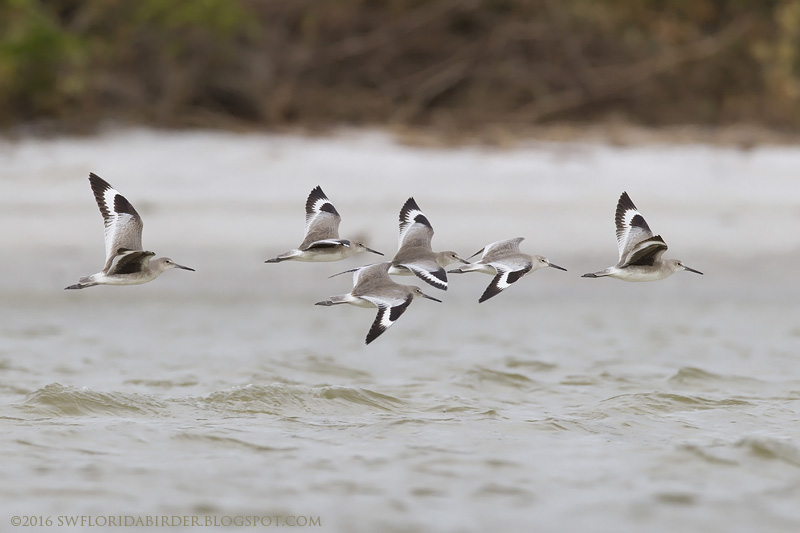
The mixed shorebirds above (image 2) were photographed at Bunche Beach Preserve in January 2016.
Fort Myers News-Press photographer Andrew West at far right and Gail Campbell to his immediate right above (image 3) were photographed at Bunche Beach Preserve in January 2016.
Possibly crossing paths with Connie at Bunche Beach Preserve on the morning of 21 January was local birding enthusiast and Bird Patrol volunteer, Gail Campbell who provided a notification to the SW Florida Bird Alert closed group Facebook webpage. Gail's report was much more timely allowing me to meet up with her and many others to see and photograph the flamingo in the mid-afternoon.
The American Flamingo above (image 4) was photographed at Bunche Beach Preserve in January 2016.
The Willet above (image 5) was photographed at Bunche Beach Preserve in January 2016.
At the beginning of the 20th century, flamingos were virtually eradicated in Florida due to plume hunting and harvesting of their eggs. Flamingos typically lay only one egg in a nesting season. In 2008, the Caribbean population of Greater Flamingo was split by the American and British Ornithologists' Unions creating the American Flamingo.
The American Flamingo above (image 6) was photographed at Bunche Beach Preserve in January 2016.
The American Flamingo above (image 7) was photographed at Bunche Beach Preserve in January 2016.
The American Flamingo is the only flamingo species found in the wild in North America. The three other New World flamingos; Chilean Flamingo, James's Flamingo and Andean Flamingo may be found in South America. The Greater Flamingo and Lesser Flamingo are now considered Old World species. Flamingos can be very long lived with one captive bird (Greater Flamingo) reaching the age of 83 before its death.
The American Flamingo above (image 8) was photographed at Bunche Beach Preserve in January 2016.
The American Flamingo above (image 9) was photographed at Bunche Beach Preserve in January 2016.
The past decade has seen a resurgence of American Flamingos in Florida, particularly at Stormwater Treatment Area 2 (STA2). There unfortunately is a huge disparity in the number of flamingos observed at STA2 from year to year with a high count of 147 in early 2014 and only eight counted in early 2015. However, there was a flamingo mating event observed by a tour group at STA2 in 2015. Flamingo field trips at STA2 are sponsored by Audubon Society of the Everglades.
The American Flamingo above (image 10) was photographed at Bunche Beach Preserve in January 2016.
The American Flamingo above (image 11) was photographed at Bunche Beach Preserve in January 2016.
Lee County has been a rare host to American Flamingos unlike the well known venues STA2, and Snake Bight located in Everglades National Park. 2015 was a boon for Lee County flamingo observations with a bird seen throughout July and another flamingo seen in early September.
The American Flamingo above (image 12) was photographed at Bunche Beach Preserve in January 2016.
The American Flamingo above (image 13) was photographed at Bunche Beach Preserve in January 2016.
The American Flamingos seen in Lee County in 2015 had a wide range from Ding Darling National Wildlife Refuge to Bunche Beach Preserve to Bowditch Point Park to Fort Myers Beach to Lovers Key State Park. A great documentation of the flamingo in the area in September was made by South Florida wildlife photographer Al Hoffacker.
The American Flamingo above (image 14) was photographed at Bunche Beach Preserve in January 2016.
The Brown Pelican above (image 15) was photographed at Bunche Beach Preserve in January 2016.
The flamingo observed in South Fort Myers in late January 2016 seems to favor the Sanibel Causeway tollbooth to Bowditch Point Park to Bunche Beach Preserve. Upon close observation the flamingo can be observed doing a highly entertaining Elvis-like shuffle when feeding.
The American Flamingo above (image 16) was photographed at Bunche Beach Preserve in January 2016.
The American Flamingo above (image 17) was photographed at Bunche Beach Preserve in January 2016.
A bonus bird seen at Bunche Beach Preserve this day was a white morph Reddish Egret with satellite tracking technology. Reddish Egrets are the rarest wading birds in the United States with a study underway to particularly identify the cause of the decline of the species in the Florida Keys.
The banded white morph Reddish Egret above (image 18) was photographed at Bunche Beach Preserve in January 2016.
Please be sure to be reminded about this weekly Southwest Florida Wildlife Blog with the email gadget located at the top of the page.
The scene above (image 19) was photographed at Bunche Beach Preserve in January 2016.
Showing posts with label american flamingo. Show all posts
Friday, January 29, 2016
Friday, July 24, 2015
Rare American Flamingo Lingers At New Pass
Now is a good time to again be reminded that it is not a good idea to ever look directly at the sun.
The Laughing Gull above (image 1) was photographed at New Pass in July 2015.
With luck, for good or bad, a Laughing Gull's trajectory had it pass directly in front of the rising sun. One should certainly prefer to have a subject like this pass in front of the 400,000 times dimmer full moon.
The Brown Pelican with American Oystercatcher above (image 2) was photographed at New Pass in July 2015.
The Tricolored Heron with American Oystercatcher above (image 3) was photographed at New Pass in July 2015.
Our eyes certainly tell us of the danger if we look at the sun. It's also particularly not a good idea to look at the sun through the viewfinder of a camera where you may be observing the extremely bright orb magnified. Such was the case on my 17 July effort to observe a very uncommon American Flamingo that had settled down at the southern end of Lovers Key State Park at New Pass.
The Great White Heron above (image 4) was photographed at New Pass in July 2015.
The American Oystercatcher above (image 5) was photographed at New Pass in July 2015.
Photography while looking in the general direction of the sun is rarely preferred. Through experimentation you may find that the sun at your back is ideal. Note the value of the Golden Hour, Blue Hour, and Twilights. Although the birds were initially mere silhouettes, it was unmistakably clear that four of them were American Oystercatcher as indicated by their display calls.
The American Oystercatcher above (image 6) was photographed at New Pass in July 2015.
The Great Blue Heron above (image 7) was photographed at New Pass in July 2015.
After about an hour with no luck in finding the flamingo, I set out for National Audubon's Corkscrew Swamp Sanctuary where Ghost Orchids live and bloom in early summer. The orchid species at the Swamp had been reported in the local news a couple of weeks earlier. That passage of time unfortunately led to blooms that looked long since peaked.
The Osprey above (image 8) was photographed at New Pass in July 2015.
The Seashore mallow above (image 9) was photographed at National Audubon Corkscrew Swamp Sanctuary in July 2015.
It was relatively quiet for bird activity along the boardwalk. The first species seen/ heard was a Northern Cardinal. Prolific as well were Red-bellied Woodpecker and Carolina Wren. A pair of Pileated Woodpecker were heard distant from one another. The wrens were ridiculously melodious above me while one captured a large spider and consumed it hastily before I was able to focus the camera on it.
The Ghost Orchid above (image 10) was photographed at National Audubon Corkscrew Swamp Sanctuary in July 2015.
The Carolina Wren above (image 11) was photographed at National Audubon Corkscrew Swamp Sanctuary in July 2015.
Black-bellied Whistling-Duck was personally observed at the Sanctuary for the first time after many visits there. When water levels are at their lowest (early to late Spring) is when wading birds are most prolific. See Hemant Kishan's reports for additional reasons to visit this remarkable place.
The Limpkin above (image 12) was photographed at National Audubon Corkscrew Swamp Sanctuary in July 2015.
The Black-bellied Whistling-Duck above (image 13) was photographed at National Audubon Corkscrew Swamp Sanctuary in July 2015.
My thanks to Tom Obrock for bringing the flamingo to my attention. Though the species was not seen on my 17 July visit to New Pass, a follow-up kayak trip on 23 July was well rewarded. The dolphins were excessively exhilarating at close range.
The American Flamingo above (image 14) was photographed at New Pass in July 2015.
Ed Weislo's website was helpful in identifying the flora this week.
The Laughing Gull above (image 1) was photographed at New Pass in July 2015.
With luck, for good or bad, a Laughing Gull's trajectory had it pass directly in front of the rising sun. One should certainly prefer to have a subject like this pass in front of the 400,000 times dimmer full moon.
The Brown Pelican with American Oystercatcher above (image 2) was photographed at New Pass in July 2015.
The Tricolored Heron with American Oystercatcher above (image 3) was photographed at New Pass in July 2015.
Our eyes certainly tell us of the danger if we look at the sun. It's also particularly not a good idea to look at the sun through the viewfinder of a camera where you may be observing the extremely bright orb magnified. Such was the case on my 17 July effort to observe a very uncommon American Flamingo that had settled down at the southern end of Lovers Key State Park at New Pass.
The Great White Heron above (image 4) was photographed at New Pass in July 2015.
The American Oystercatcher above (image 5) was photographed at New Pass in July 2015.
Photography while looking in the general direction of the sun is rarely preferred. Through experimentation you may find that the sun at your back is ideal. Note the value of the Golden Hour, Blue Hour, and Twilights. Although the birds were initially mere silhouettes, it was unmistakably clear that four of them were American Oystercatcher as indicated by their display calls.
The American Oystercatcher above (image 6) was photographed at New Pass in July 2015.
The Great Blue Heron above (image 7) was photographed at New Pass in July 2015.
After about an hour with no luck in finding the flamingo, I set out for National Audubon's Corkscrew Swamp Sanctuary where Ghost Orchids live and bloom in early summer. The orchid species at the Swamp had been reported in the local news a couple of weeks earlier. That passage of time unfortunately led to blooms that looked long since peaked.
The Osprey above (image 8) was photographed at New Pass in July 2015.
The Seashore mallow above (image 9) was photographed at National Audubon Corkscrew Swamp Sanctuary in July 2015.
It was relatively quiet for bird activity along the boardwalk. The first species seen/ heard was a Northern Cardinal. Prolific as well were Red-bellied Woodpecker and Carolina Wren. A pair of Pileated Woodpecker were heard distant from one another. The wrens were ridiculously melodious above me while one captured a large spider and consumed it hastily before I was able to focus the camera on it.
The Ghost Orchid above (image 10) was photographed at National Audubon Corkscrew Swamp Sanctuary in July 2015.
The Carolina Wren above (image 11) was photographed at National Audubon Corkscrew Swamp Sanctuary in July 2015.
Black-bellied Whistling-Duck was personally observed at the Sanctuary for the first time after many visits there. When water levels are at their lowest (early to late Spring) is when wading birds are most prolific. See Hemant Kishan's reports for additional reasons to visit this remarkable place.
The Limpkin above (image 12) was photographed at National Audubon Corkscrew Swamp Sanctuary in July 2015.
The Black-bellied Whistling-Duck above (image 13) was photographed at National Audubon Corkscrew Swamp Sanctuary in July 2015.
My thanks to Tom Obrock for bringing the flamingo to my attention. Though the species was not seen on my 17 July visit to New Pass, a follow-up kayak trip on 23 July was well rewarded. The dolphins were excessively exhilarating at close range.
The American Flamingo above (image 14) was photographed at New Pass in July 2015.
Ed Weislo's website was helpful in identifying the flora this week.
Saturday, November 5, 2011
American Avocet At Bunche Beach
The temperatures here in southwest Florida were a few degrees below normal this week in the eighties for highs as the northeastern United States was pummeled with an unusually early snowstorm.
The Reddish Egret above was photographed at Bunche Beach Preserve in November 2011.
I'm not sure the affect this might have on the theory global warming.
Plans to take advantage of what might have been very good conditions for warbler action at Six Mile Cypress Preserve following a storm front were lost with a need for rest.
The Reddish Egret above was photographed at Bunche Beach Preserve in November 2011.
The next opportunity to look for Florida Scrub Jay was postponed as well feeling a little under the weather and possibly not offering an update this week.
I heard from Tom Obrock advising me that he had a sighting of the species found only in Florida while posting great photos of the species.
The Reddish Egret above was photographed at Bunche Beach Preserve in November 2011.
It was too late for me to make tracks north in his direction and was on the way to Bunche Beach with slim hopes that the very rare Greater Flamingo might be seen.
With this species as daunting a find as the scrub jay in my wildlife observations, I was content with hopes of seeing oystercatcher, avocet, and the significantly less likely Merlin coincidentally seen at the beach I would travel to.
The Willet above was photographed at Bunche Beach Preserve in November 2011.
I arrived at Bunche at an unusual hour around midday (preferring sunrise or late afternoon) with the tide at its low.
This is not considered a good time of day for photography, but I attempted to make the best of.
The Semipalmated Plover above was photographed at Bunche Beach Preserve in November 2011.
I like how a negative exposure bias setting increases the shutter speed in AV (aperture) mode while unfortunately the opposite happens with the need to improve light of a dark subject against a bright background typically.
This control of the camera will hopefully give photography enthusiasts a little more courage to capture their images under the widely considered unfavorable condition.
The Least Sandpiper above was photographed at Bunche Beach Preserve in November 2011.
This would likely be particularly useful for photography of wildlife subjects in areas where the sun is even closer to the horizon the further you get north from the equator at this time of year.
The especially bright light source allows one to favorably utilize an aperture setting that expands the area of sharpness of the subject that as a detraction reduces your shutter speed for action shots.
The Snowy Egret above was photographed at Bunche Beach Preserve in November 2011.
Selective enhancements of some of the images have been made in post processing to improve the overall result to my preference while the ultimate goal is to eliminate the need for anything more than a minor adjustment of an image with merely sharpening a goal.
The first few images of this blog entry were taken with experimental exposure bias settings with results I think are appealing considering the time of day.
The American Avocet above was photographed at Bunche Beach Preserve in November 2011.
Before my arrival with the intent to stay until sunset, I traveled to the Sanibel toll plaza (western fringe of Bunche Beach Preserve) to scan the bay where the flamingo had recently been seen.
I grappled briefly with some clouds that passed over the Preserve which offered an additional challenge in photographing the wildlife.
The Black-bellied Plover above was photographed at Bunche Beach Preserve in November 2011.
There were a significant number of Least Sandpiper, Black Skimmer and Laughing Gulls on the flats, but no flamingo.
The wind was strong from the north on the day of my observations which kept the water level in San Carlos Bay lower than it might have been otherwise.
The American Avocet with Short-billed Dowitcher above was photographed at Bunche Beach Preserve in November 2011.
At Bunche Beach Preserve from the John Morris Road parking area I made my way beyond the west channel where I observed a Tricolored Heron and Reddish Egret that were especially active in their feeding behavior.
I devoted much time to observing these birds with otherwise primarily Least Sandpiper seen working the sea grass for their survival.
The primarily Least Sandpiper above were photographed at Bunche Beach Preserve in November 2011.
With the flats exposed to the extent they were, the birds were scattered over a very wide range.
It wasn't long before I filled the 8GB memory card of the camera and had to return home for the 32GB card I've been spoiled by thanks to Tim Rucci.
The American Oystercatcher juvenile above was photographed at Bunche Beach Preserve in November 2011.
With my anticipated upgrade to the Canon Mark V when it becomes available (saving now), a 128GB card will hopefully be reasonably priced.
Although I gave a brief thought to calling it a day after my return home, none of my target species had been seen and I was excited by the favorable tide conditions with the possibility for good light through the late afternoon.
The American Avocet above was photographed at Bunche Beach Preserve in November 2011.
So I made the return trek to one of the greatest wildlife beach venues I know of.
The shorebirds in particular at Bunche Beach will congregate at much closer range in a predictable manner as the tide rises from its low.
The Forster's Tern above was photographed at Bunche Beach Preserve in November 2011.
This event occurs as long as they are not disturbed by humans or one of their predators.
I walked further into the bay than I had earlier and was rewarded with the sighting of an American Avocet.
The American Avocet with Forster's Tern above was photographed at Bunche Beach Preserve in November 2011.
The bird was among a flock of primarily Short-billed Dowitcher with a lone Black-bellied Plover although other of the latter be heard calling to it from not too great a distance.
I consider the American Avocet one of the more beautiful species of bird and was fortunate to observe the characteristic side to side motion of its bill indicative of its feeding behavior.
The Caspian Tern above was photographed at Bunche Beach Preserve in November 2011.
As time went on and the birds were forced closer together, a lone Caspian Tern was also a standout in the crowd.
I initially thought the Caspian was a Royal Tern, but closer inspection of the bird on the computer clearly showed evidence of a dusky tip of the bill indicating Caspian.
The American Avocet above was photographed at Bunche Beach Preserve in November 2011.
My second target species, American Oystercatcher, would make an extended appearance before flying off the the east which was the direction it had arrived from.
This was a special treat with the oystercatcher a juvenile as noted by its darker bill.
The Sanderling above was photographed at Bunche Beach Preserve in November 2011.
Its parent remained closer to the shoreline while I wonder if this was the same oystercatcher observed last week while I didn't see the juvenile at that time.
Dozens of Sanderling arrived about a half hour before sunset.
The American Avocet above was photographed at Bunche Beach Preserve in November 2011.
Upwards of a hundred Least Sandpiper were very active in flight in the immediate area.
I was entranced by the dominant behavior of Forster's Tern, a much smaller bird than the avocet, which numerous times discouraged the avocet from approaching too closely to its territory which didn't appear more than a few square feet.
The sunset above was photographed at Bunche Beach Preserve in November 2011.
At the near exact moment of sunset, the avocet would bathe briefly which regrettably wasn't photographed in better light.
While the Merlin failed to make an appearance, the flamingo failed to show as well and remains a nemesis bird seen in the wild.
The American Avocet above was photographed at Bunche Beach Preserve in November 2011.
My visit to Bunche Beach Preserve this week was nonetheless one of the more enjoyable experiences I've had observing the wildlife there.
The Reddish Egret above was photographed at Bunche Beach Preserve in November 2011.I'm not sure the affect this might have on the theory global warming.
Plans to take advantage of what might have been very good conditions for warbler action at Six Mile Cypress Preserve following a storm front were lost with a need for rest.
The Reddish Egret above was photographed at Bunche Beach Preserve in November 2011.The next opportunity to look for Florida Scrub Jay was postponed as well feeling a little under the weather and possibly not offering an update this week.
I heard from Tom Obrock advising me that he had a sighting of the species found only in Florida while posting great photos of the species.
The Reddish Egret above was photographed at Bunche Beach Preserve in November 2011.It was too late for me to make tracks north in his direction and was on the way to Bunche Beach with slim hopes that the very rare Greater Flamingo might be seen.
With this species as daunting a find as the scrub jay in my wildlife observations, I was content with hopes of seeing oystercatcher, avocet, and the significantly less likely Merlin coincidentally seen at the beach I would travel to.
The Willet above was photographed at Bunche Beach Preserve in November 2011.I arrived at Bunche at an unusual hour around midday (preferring sunrise or late afternoon) with the tide at its low.
This is not considered a good time of day for photography, but I attempted to make the best of.
The Semipalmated Plover above was photographed at Bunche Beach Preserve in November 2011.I like how a negative exposure bias setting increases the shutter speed in AV (aperture) mode while unfortunately the opposite happens with the need to improve light of a dark subject against a bright background typically.
This control of the camera will hopefully give photography enthusiasts a little more courage to capture their images under the widely considered unfavorable condition.
The Least Sandpiper above was photographed at Bunche Beach Preserve in November 2011.This would likely be particularly useful for photography of wildlife subjects in areas where the sun is even closer to the horizon the further you get north from the equator at this time of year.
The especially bright light source allows one to favorably utilize an aperture setting that expands the area of sharpness of the subject that as a detraction reduces your shutter speed for action shots.
The Snowy Egret above was photographed at Bunche Beach Preserve in November 2011.Selective enhancements of some of the images have been made in post processing to improve the overall result to my preference while the ultimate goal is to eliminate the need for anything more than a minor adjustment of an image with merely sharpening a goal.
The first few images of this blog entry were taken with experimental exposure bias settings with results I think are appealing considering the time of day.
The American Avocet above was photographed at Bunche Beach Preserve in November 2011.Before my arrival with the intent to stay until sunset, I traveled to the Sanibel toll plaza (western fringe of Bunche Beach Preserve) to scan the bay where the flamingo had recently been seen.
I grappled briefly with some clouds that passed over the Preserve which offered an additional challenge in photographing the wildlife.
The Black-bellied Plover above was photographed at Bunche Beach Preserve in November 2011.There were a significant number of Least Sandpiper, Black Skimmer and Laughing Gulls on the flats, but no flamingo.
The wind was strong from the north on the day of my observations which kept the water level in San Carlos Bay lower than it might have been otherwise.
The American Avocet with Short-billed Dowitcher above was photographed at Bunche Beach Preserve in November 2011.At Bunche Beach Preserve from the John Morris Road parking area I made my way beyond the west channel where I observed a Tricolored Heron and Reddish Egret that were especially active in their feeding behavior.
I devoted much time to observing these birds with otherwise primarily Least Sandpiper seen working the sea grass for their survival.
The primarily Least Sandpiper above were photographed at Bunche Beach Preserve in November 2011.With the flats exposed to the extent they were, the birds were scattered over a very wide range.
It wasn't long before I filled the 8GB memory card of the camera and had to return home for the 32GB card I've been spoiled by thanks to Tim Rucci.
The American Oystercatcher juvenile above was photographed at Bunche Beach Preserve in November 2011.With my anticipated upgrade to the Canon Mark V when it becomes available (saving now), a 128GB card will hopefully be reasonably priced.
Although I gave a brief thought to calling it a day after my return home, none of my target species had been seen and I was excited by the favorable tide conditions with the possibility for good light through the late afternoon.
The American Avocet above was photographed at Bunche Beach Preserve in November 2011.So I made the return trek to one of the greatest wildlife beach venues I know of.
The shorebirds in particular at Bunche Beach will congregate at much closer range in a predictable manner as the tide rises from its low.
The Forster's Tern above was photographed at Bunche Beach Preserve in November 2011.This event occurs as long as they are not disturbed by humans or one of their predators.
I walked further into the bay than I had earlier and was rewarded with the sighting of an American Avocet.
The American Avocet with Forster's Tern above was photographed at Bunche Beach Preserve in November 2011.The bird was among a flock of primarily Short-billed Dowitcher with a lone Black-bellied Plover although other of the latter be heard calling to it from not too great a distance.
I consider the American Avocet one of the more beautiful species of bird and was fortunate to observe the characteristic side to side motion of its bill indicative of its feeding behavior.
The Caspian Tern above was photographed at Bunche Beach Preserve in November 2011.As time went on and the birds were forced closer together, a lone Caspian Tern was also a standout in the crowd.
I initially thought the Caspian was a Royal Tern, but closer inspection of the bird on the computer clearly showed evidence of a dusky tip of the bill indicating Caspian.
The American Avocet above was photographed at Bunche Beach Preserve in November 2011.My second target species, American Oystercatcher, would make an extended appearance before flying off the the east which was the direction it had arrived from.
This was a special treat with the oystercatcher a juvenile as noted by its darker bill.
The Sanderling above was photographed at Bunche Beach Preserve in November 2011.Its parent remained closer to the shoreline while I wonder if this was the same oystercatcher observed last week while I didn't see the juvenile at that time.
Dozens of Sanderling arrived about a half hour before sunset.
The American Avocet above was photographed at Bunche Beach Preserve in November 2011.Upwards of a hundred Least Sandpiper were very active in flight in the immediate area.
I was entranced by the dominant behavior of Forster's Tern, a much smaller bird than the avocet, which numerous times discouraged the avocet from approaching too closely to its territory which didn't appear more than a few square feet.
The sunset above was photographed at Bunche Beach Preserve in November 2011.At the near exact moment of sunset, the avocet would bathe briefly which regrettably wasn't photographed in better light.
While the Merlin failed to make an appearance, the flamingo failed to show as well and remains a nemesis bird seen in the wild.
The American Avocet above was photographed at Bunche Beach Preserve in November 2011.My visit to Bunche Beach Preserve this week was nonetheless one of the more enjoyable experiences I've had observing the wildlife there.
Subscribe to:
Posts (Atom)