Showing posts with label caloosa bird club. Show all posts

Friday, June 3, 2016

Wildlife At Miami's Matheson Hammock Park

At the suggestion of Tom Obrock we made a late May trip to Florida's east coast with the possibility of observing Bahama Mockingbird, a rare bird species in Florida, that had been reported in Fort Lauderdale at eBird.


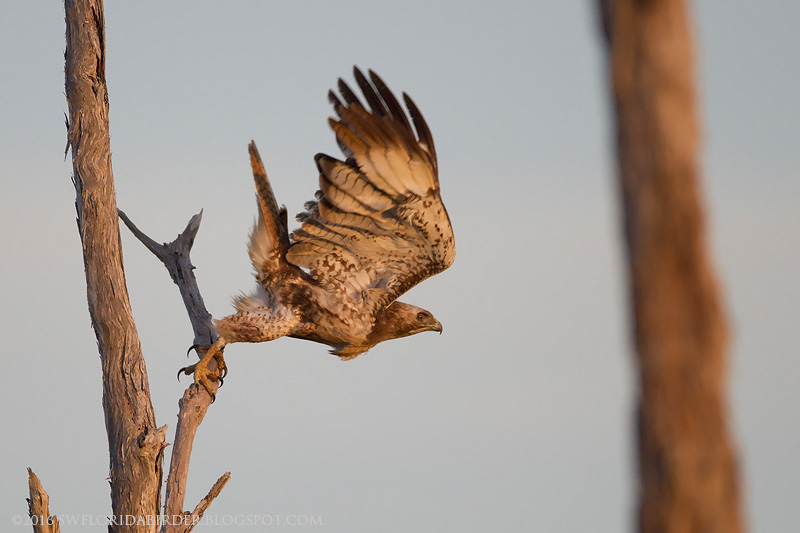
The immature Red-tailed Hawk above (image 1) was photographed near Homestead in May 2016.

Before leaving the limits of Fort Myers we decided instead to head toward Miami as the mockingbird had not been reported in a couple of days. The Baptist Hospital of Miami was our first stop after observing a Red-tailed Hawk being harassed by a Red-winged Blackbird north of Homestead. There was no luck in finding Egyptian Geese that should be expected. Tom and I then devoted much time in a search of Red-whiskered Bulbul in the area of the hospital which was elusive as well.


The immature Red-tailed Hawk above (image 2) was photographed near Homestead in May 2016.


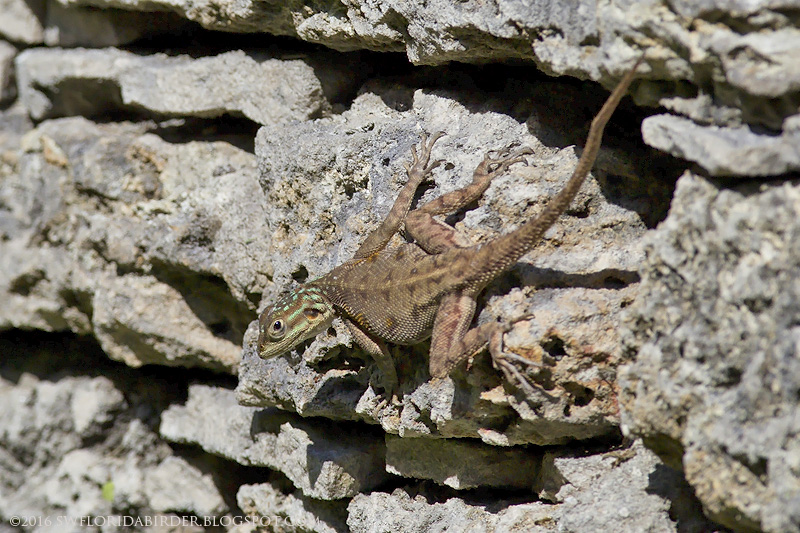
The Red-headed Rock Agama above (image 3) was photographed at Matheson Hammock Park in May 2016.


The Eastern Puerto Rican Crested Anole above (image 4) was photographed at Matheson Hammock Park in May 2016.

Matheson Hammock, our next stop, offered a lifebird for both Tom and I as a handful of Orange-winged Parrot made a direct flyover from the north in the area north of Camp Mahachee at the far west fringe of the park. I regrettably had to forfeit the photography of the birds to put Tom on them. Many invasive lizards were seen at this park as well which turned out to be a highlight of the trip.


The Red-headed Rock Agama above (image 5) was photographed at Matheson Hammock Park in May 2016.


The Zebra Longwing Butterfly above (image 6) was photographed at Matheson Hammock Park in May 2016.


The Red-headed Rock Agama above (image 7) was photographed at Matheson Hammock Park in May 2016.

After leaving Matheson Hammock Park we devoted much time in search of parakeets in the neighborhoods north and northeast of Miami International Airport. We remained unsuccessful in our search with David A. Sibley noting that no native parrot species remain in North America though 65 imported species have been recorded in Florida at the October 2000 publication of his Guide to Birds. He noted that many feral populations may exist. Sibley's 2nd Edition would certainly be the preferred version to consider at the time of this writing.


The Red-headed Rock Agama above (image 8) was photographed at Matheson Hammock Park in May 2016.


The Red-bellied Woodpecker above (image 9) was photographed at Matheson Hammock Park in May 2016.


The Green Iquana above (image 10) was photographed at Matheson Hammock Park in May 2016.

Without the help of the Tropical Audubon Society it is hoped that at least one more journey to the Miami area can be made in search of exotics to add a few more unseen species of parakeet to the list.


The Red-headed Rock Agama above (image 11) was photographed at Matheson Hammock Park in May 2016.


The Red-headed Rock Agama above (image 12) was photographed at Matheson Hammock Park in May 2016.

Please be sure to be reminded about this weekly Southwest Florida Wildlife Blog with the email gadget located at the top of the page.


The Red-headed Rock Agama above (image 13) was photographed at Matheson Hammock Park in May 2016.

Saturday, October 13, 2012

Do Rufous Hummingbirds Sing

It is a very rare occasion when I begin composition of this weekly wildlife article before an image has been taken to accompany it.


The Red-bellied Woodpecker above was photographed at the Damon residence in October 2012.

The excitement I have in observation of a Rufous Hummingbird (a lifer) is resulting in what is commonly called insomnia. I'll likely squeeze in a couple hours sleep while I fear I will not wake in time to experience this spectacle now committed to. My thanks are extended to Stan Damon for his invitation to see this species which has been present for at least 16 days before dawn on 8 October in Lehigh Acres. I hope for the best considering a steady rain for the last five hours. Stan, Vince McGrath, and Vince's longtime friend Ed Becker from New Hampshire will be making a trip to the sod fields this morning with my envy of that trip as well. There has been an abundance of rain these past weeks in our subtropical climate which will impact spring observations already thought about. A ray of sunlight at dawn in observation of the hummer is hoped for decent photography and documentation of the bird. Before the observation effort I have had the thought, "Do hummingbirds sing," like commonly seen birds? Investigation has divulged that hummingbirds have a very rapid chirping. Their song is nearly overwhelmed by the flapping of its wings which sounds like a bee when the bird is on the move. I recommend you research this further. The rain has stopped and the night sky appears to be clearing. I can finally get to sleep now. The morning was not a loss after sleeping through the clock's alarm. I got a wake up call from Tom Obrock advising me that he was observing the hummingbird. By the time I got to the Damon home, Tom was in Alva observing Merlin and Red-headed Woodpecker. Mrs. Damon was a very gracious and enjoyable host to spend the late morning with. Mitzi coined the Merlin as the Cheetah of the Falcon world after I noted it as the fastest predator I had yet seen. Mitzi and I watched the hummingbird appear numerous times in less than a few hours time. In fact there were two of the species observed with thought of female or juvenile with the dominant male. The sightings were made from from a distance of sixty plus feet. This was especially far to observe and photograph a bird less than four inches in length. I was reluctant to get closer until I had an understanding of the behavior of the bird. The Rufous Hummingbird is known to have territorial dominance over other hummer species twice its weight as well as those of its own kind. A follow-up visit was made to the Damon's place on day 21 of the Rufous Hummingbird's presence. I met Mitzi walking her dog while driving through the neighborhood before dawn. I greeted Stan a few minutes later as he was picking up the morning newspaper. We immediately began our observation for the hummer which appeared on cue. The hummingbird put on an incredible show as it darted from one citrus tree perch to another. The bird's tongue was seen frequently as it seemingly tasted the air (hummingbirds are thought to have have minimal taste function and don't taste the air) while it indulged in preening itself on a few occasions. The dominant male was the only Rufous Hummingbird personally observed this day although Stan has photographic evidence of four distinct birds of this species in his backyard since the Rufous Hummingbird's first sighting. The time passed all too quickly as I enjoyed viewing photographs Stan has taken of the wildlife he's seen in the area. Ruth Woodall, a Birdpatrol guide, and Ken Hodgson, Caloosa Bird Club Chairman and New Yorker, arrived before I parted ways. The Caloosa Bird Club is celebrating its 53rd year. One of the most remarkable stories I heard was of a Snail Kite that was consumed for breakfast by a Great Horned Owl in Stan's front yard. Stan advised me that the Peregrine Falcon has quicker mobility than Merlin with PEFA noted as the fastest animal in the world. Although Vince has speculated that the Rufous Hummingbird(s) may overwinter in Lehigh Acres, Stan commented to me that he believes the dominant bird is recovering from a molt, and may move on when its feathers are grown in. There was discussion of a wildlife venue I have yet visited which I hope to be able to mention in detail in the future with Ruth's approval.


The Northern Cardinal above was photographed at the Damon residence in October 2012.


The Mourning Dove above was photographed at the Damon residence in October 2012.


The female Rufous Hummingbird above was photographed at the Damon residence in October 2012.


The Rufous Hummingbird above was photographed at the Damon residence in October 2012.


The Rufous Hummingbird above was photographed at the Damon residence in October 2012.


The Rufous Hummingbird above was photographed at the Damon Residence in October 2012.


The Rufous Hummingbird above was photographed at the Damon residence in October 2012.


The Rufous Hummingbird above was photographed at the Damon residence in October 2012.


The Rufous Hummingbird above was photographed at the Damon residence in October 2012.


The Rufous Hummingbird above was photographed at the Damon Residence in October 2012.


The Rufous Hummingbird above was photographed at the Damon residence in October 2012.


The Rufous Hummingbird above was photographed at the Damon residence in October 2012.


The Rufous Hummingbird above was photographed at the Damon residence in October 2012.


The Rufous Hummingbird above was photographed at the Damon residence in October 2012.


The Rufous Hummingbird above was photographed at the Damon residence in October 2012.


The Rufous Hummingbird above was photographed at the Damon residence in October 2012.


The Rufous Hummingbird above was photographed at the Damon residence in October 2012.


The Rufous Hummingbird above was photographed at the Damon residence in October 2012.


The Rufous Hummingbird above was photographed at the Damon residence in October 2012.


The Rufous Hummingbird above was photographed at the Damon residence in October 2012.


The Rufous Hummingbird above was photographed at the Damon residence in October 2012.


The Rufous Hummingbird above was photographed at the Damon residence in October 2012.


The Rufous Hummingbird above was photographed at the Damon residence in October 2012.


The Rufous Hummingbird above was photographed at the Damon residence in October 2012.


The Rufous Hummingbird above was photographed at the Damon residence in October 2012.


The Rufous Hummingbird above was photographed at the Damon residence in October 2012.


The Rufous Hummingbird above was photographed at the Damon residence in October 2012.


The Rufous Hummingbird above was photographed at the Damon residence in October 2012.


The Rufous Hummingbird above was photographed at the Damon residence in October 2012.


The Rufous Hummingbird above was photographed at the Damon residence in October 2012.


The Rufous Hummingbird above was photographed at the Damon residence in October 2012.


The Rufous Hummingbird above was photographed at the Damon residence in October 2012.


The Rufous Hummingbird above was photographed at the Damon residence in October 2012.

Saturday, October 29, 2011

Elusive Flamingo At Bunche Beach

In early September 2011 I was astounded to hear from workmate Mike Peters that he had seen an American Flamingo in the area.

The White Ibis above was photographed at Bunche Beach Preserve in October 2011.

Mike has been observing at least a pair of the species while fishing the waters in the vicinity of Ding Darling National Wildlife Refuge as has been reported here.

Preceding my days off from work this week, Gayle Sheets, webmaster of BirdPatrol.org and Media Coordinator for Lee County's Bird Patrol, was kind enough to forward me an image of the flamingo taken near Bunche Beach Preserve.

The Peregrine Falcon above was photographed at Bunche Beach Preserve in October 2011.

With a chance of observing the species from land, and at one of my favorite wildlife venues, I made three visits to the Preserve with hopes of making my first observation of the rarely seen bird.

My first visit to Bunche was in the late afternoon upon reading Gayle's email.

The Black Skimmer above was photographed at Bunche Beach Preserve in October 2011.

The tide I thought was favorably low for observation of the flamingo, but would be told the following morning by a fellow visitor to the Preserve that the flamingo would more likely be seen in deeper water based on its preferred foraging behavior.

My visit to Bunche on the second day was a morning trip which allowed for observation of the greatest numbers of Tricolored Heron I'd yet seen with upwards of forty of them either in the water or in flight.

The Snowy Egret above was photographed at Bunche Beach Preserve in October 2011.

I would learn the lesson this particular morning not to allow a camera battery to fail in use as I lost a series of images of Great Blue Heron giving a stunning chase of a juvenile in a territorial dispute.

A moment later I also had a very close flyby of a juvenile Little Blue Heron.

The Little Blue Heron juvenile above was photographed at Bunche Beach Preserve in October 2011.

It was a treat to finally meet Gayle as she visited the Preserve this day and noted how excited she was to walk in the bay as she hadn't before.

Also visiting the Preserve to partake in the remarkable birdwatching opportunities were Joanne and Mickey with the Caloosa Bird Club and Ruth affiliated with the Bird Patrol.

The Great Blue Heron with Tricolored Heron above was photographed at Bunche Beach Preserve in October 2011.

My third visit to Bunche Beach Preserve this week was delayed by a couple of hours with a need to replace the car battery.

My arrival to the beach this last day offered a view of a photographer in the water whom I had seen when leaving the day before.

The Tricolored Heron above was photographed at Bunche Beach Preserve in October 2011.

I would learn that this was pbase contributor and Royal Canadian Mounted Police Constable, Robert Doiron from New Brunswick.

Robert told be that he has a particular interest in shorebirds with there no better place I know of to observe them than where he was.

Robert Doiron above was photographed at Bunche Beach Preserve in October 2011.

The flamingo remained elusive while there was plenty of other action to keep a wildlife enthusiast entertained.

One didn't even need to get in the water as the rising tides brought the birds closer and closer to shore.

The Little Blue Heron above was photographed at Bunche Beach Preserve in October 2011.

The flamingo had been sighted at Bunche Beach near the Sanibel toll plaza this past week and reported in a news story of the event.

Gayle was mentioned in the story noting that nine of the species were observed flying north over Barefoot Beach in Bonita Springs to the south.

The Marbled Godwit above was photographed at Bunche Beach Preserve in October 2011.

Naturalist Vince McGrath was noted as saying that he believed the bird seen at Bunche was likely a juvenile as it lacked deep pink coloration in its feathers which can similarly be noted with juvenile Roseate Spoonbills.

He also added that the flamingos may be escapees from tourist attractions or zoos as the bird observed near the Sanibel Causeway was tolerant of its close approach.

The American Oystercatcher above was photographed at Bunche Beach Preserve in October 2011.

Robert made the point of telling me how tame the birds are that he's observed here while those he sees in Canada will take flight as soon as they see him from a great distance in many cases.

Imagine the scene described by Mike 20 years ago when he observed about a hundred of the flamingos together in these San Carlos Bay waters.

The Wood Stork above was photographed at Bunche Beach Preserve in October 2011.

I'm very optimistic that the flamingos will choose to stay in the area through the winter months.