Showing posts with label insects. Show all posts

Monday, April 16, 2012

Guest Contribution By Hemant Kishan

It is a great pleasure to present to you a guest contribution which I hope is one of many by Hemant Kishan, Director of Strategy and Planning, with the General Motors Company . . .

Finding Vireos at Corkscrew Swamp Sanctuary, Naples, Florida

Two species of vireo are common at Corkscrew Swamp -- the White-Eyed and the Blue-Headed. Both can be found with relative ease but photographing them is another story as they tend to be secretive and inconspicuous; especially the white-eyed vireo.


The blue-headed vireo, as seen above, is the larger of the two. Its appearance is distinctive with prominent "white spectacles" and a blue/grey head. Unlike the white-eyed, the blue-headed is not a resident breeder at Corkscrew and prefers, like the many "snow birds" who live seasonally in Florida, to spend only the winters here; leaving for its breeding grounds in the Northern reaches of the US and Canada in the Summer.


The blue-headed vireo can often be found in mixed feeding flocks at Corkscrew Swamp with gnatcatchers and warblers. It is, however, not a flocking bird and does not nest in colonies. It moves quickly through the greenery, picking off insects for food.


Curiously, it was only in 1997 that the Blue-Headed Vireo (seen in the above three images) was recognized as a true species. Earlier, what we now know as the blue-headed, Cassin's and Plumbeous vireos were lumped into a single species known as the "Solitary Vireo". Thanks to genetic and song analysis, all three now have full species status.


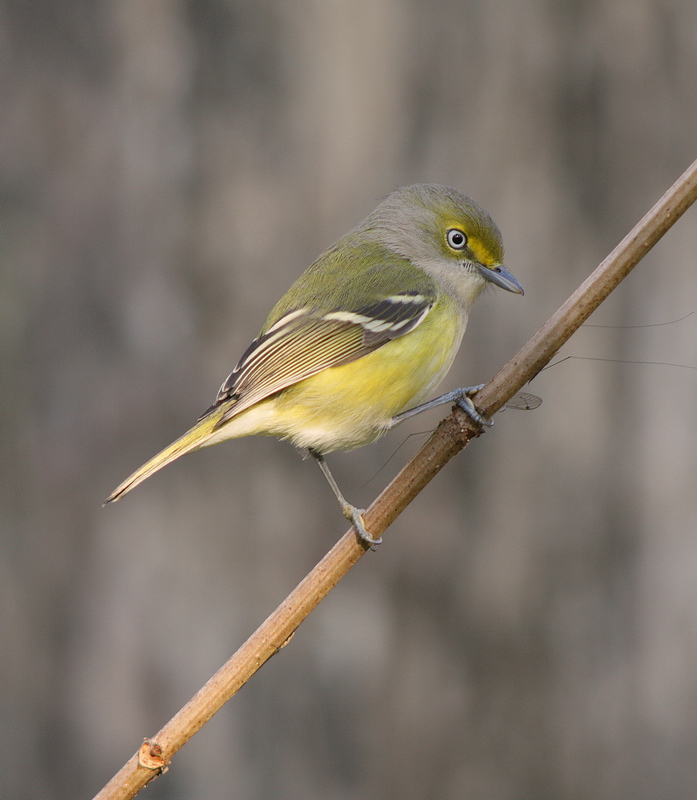
No prizes for guessing the origins of this vireo's name! The white-eyed vireo (as seen in the image directly above and the four below) is a small, secretive vireo with dazzling white eyes. The white eyes are a sign of maturity with the juveniles of the species having a dark iris instead. They are a strictly monogamous species that attaches its nest to trees using spider webs!


The white eyed vireo has yellow spectacles with a white throat and two white bars on its wings. Like many other vireo species, the coloration is subdued with a combination of green, olive, white and grey.


White-eyed vireos can turn up anywhere along the boardwalk at Corkscrew. I have usually found them singly but also infrequently in mixed flocks. Early mornings are best and, if you're lucky like I was, sometimes, the best technique is to be absolutely still and let them approach you as they feed.


White-eyed vireos are usually found in low thickets at Corkscrew. They are one of only two perching bird species found in the United States that have white eyes; so their name is also a diagnostic identifying feature of these handsome, small vireos that are found widely in Florida -- from mangroves to scrubland habitat.


In the picture immediately above, a white-eyed vireo has just caught a "daddy long legs," and if you look carefully you can see one of its wings and legs. While predominantly insectivorous, white-eyed vireos will also consume berries in Winter.

Next time you're out birding, look for this attractive neotropical bird and a great place to find it is at Corkscrew Swamp Sanctuary.

Friday, November 11, 2011

Bald Eagles And Sand Sculptures: 2011

Day 1:

I had been giving a lot of thought this past month to revisiting the Bald Eagle nest south of Fort Myers Beach at Big Carlos Pass.

The sunrise above was photographed at Lovers Key State Park in November 2011.

A primary goal in my wildlife observations to close out the year is to capture the mating behavior of the raptor.

I'm well aware of the fact that this may require countless hours of observation and will certainly have a tremendous amount of luck if I'm successful.

The Mangrove Skipper above was photographed at Lovers Key State Park at Big Carlos Pass in November 2011.

Comfortable conditions with an unobstructed sunrise were welcome during my first chance to make my observations this week.

A bird call that I was unsure of was heard upon my arrival at Lovers Key State Park.

The Obscure Skipper above was photographed at Lovers Key State Park at Big Carlos Pass in November 2011.

The mosquitoes that have been reported to be at their worst in 20 years with heavy rains in October were virtually absent while sand gnats were aggressive early in the day.

My approach to the eagle nest allowed observation of a bird in the nest with the bird's mate in a nearby tree.

The Gulf Fritillary above was photographed at Lovers Key State Park at Big Carlos Pass in November 2011.

Both birds took flight upon my first glimpse of them.

The eagles were heard occasionally from different directions in the next few hours as I waited for their return to view.

The Belted Kingfisher above was photographed at Lovers Key State Park at Big Carlos Pass in November 2011.

It's my expectation to find that these are the same Bald Eagles that I observed at the nest earlier this year.

I'll be assured when I note the band on one of the legs of the birds.

The scene above was photographed at Fort Myers Beach in November 2011.

Gloria Beauchamp, park manager at Lovers Key, has noted that the Bald Eagle has been seen in all areas of the Park.

At one point I thought I had observed a woodpecker I had not seen before, but it turned out to be a Belted Kingfisher after close inspection of its image on the computer.

The scene above was photographed at Fort Myers Beach in November 2011.

Blue-gray Gnatcatchers were the most abundant species seen with one individual working its way through a shrub merely a few feet away allowing a remarkable view of the diminutive bird.

Insect life was prolific as well with bees particularly active around me.

The scene above was photographed at Fort Myers Beach in November 2011.

I would again make an identification request of Vince Lucas to help confirm a species seen.

He guided me in the right direction while concluding the creature to be an Obscure Skipper after making comparisons with Brian Ahern's imagery.

The scene above was photographed at Fort Myers Beach in November 2011.

Particularly vocal later in the morning during my observations were kingfishers and Ospreys.

The guttural calls of White Ibis were heard as they fed in one of the park's inner waterways though were obscured from view by the thick mangrove trees.

The scene above was photographed at Fort Myers Beach in November 2011.

Heading home I stopped at Fort Myers Beach to see the sand sculptures built during the 25th Annual American SandSculpting Championship Festival held behind the GullWing Resort.

Also celebrating its 25th anniversary is the World Championship of Sand Sculpting that will be held November 17-27, 2011 behind the Holiday Inn at Fort Myers Beach.

The scene above was photographed at Fort Myers Beach in November 2011.

The sand sculptures seen created at the American event were very impressive days after the sculptures were created.

They still attracted many visitors on the day of my visit while it is believed that 50,000 people attended the event the week before.

The scene above was photographed at Fort Myers Beach in November 2011.

The sculptures were very diverse in their themes and of many varying sizes with a few dwarfing those admiring them.

The space limitations here regrettably only offers a small representation of what was seen with a photo gallery on this subject created as time permits.

The scene above was photographed at Fort Myers Beach in November 2011.

If I'm fortunate enough to view the creations at the World Championship, it will be many months before I complete such an endeavor.

Day 2:

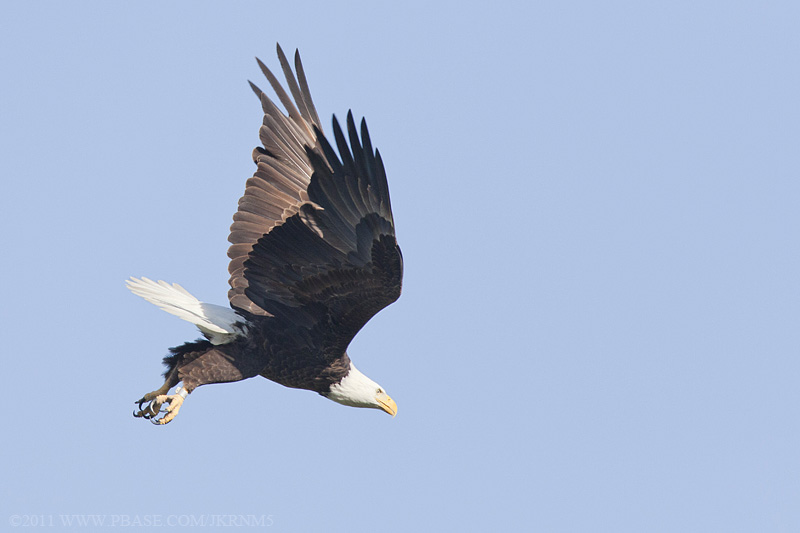
The Bald Eagle above was photographed at Lovers Key State Park at Big Carlos Pass in November 2011.

The morning of my trip back to attempt to observe the Bald Eagles at Lovers Key was met with a rare opportunity to observe a near full moonset in nighttime conditions.

I've only had this experience once before and have great regret for missing the chance to photograph the moon dipping below the horizon.

The Red-bellied Woodpecker above was photographed at Lovers Key State Park at Big Carlos Pass in November 2011.

On the previous occasion, I'm quite sure I was making a trip to observe the eagles.

The sounds heard at the parking area were not repeated on this day discounting further investigation.

The Bald Eagle above was photographed at Lovers Key State Park at Big Carlos Pass in November 2011.

Arrival near the Bald Eagle nest was fortuitous as the birds seemed to remember me and remained in view.

Woodpeckers were much more prevalent this day with three species seen including Red-bellied, Downy and Pileated.

The Pileated Woodpecker above was photographed at Lovers Key State Park at Big Carlos Pass in November 2011.

The Pileated Woodpecker, significantly larger than the other woodpeckers, allowed the most interesting audible treat with its distinctive drumming created on the trees.

I was offered many more species of bird passing through on this day while a few others were absent.

The Downy Woodpecker above was photographed at Lovers Key State Park at Big Carlos Pass in November 2011.

Such is the case with wildlife observation while we can occasionally take advantage of reports of species for up to weeks at a time in search of a rarity.

I caught a glimpse of what I immediately recognized as flycatcher and would compare my recollection of it to the only image I've captured of Great Crested Flycatcher nearly four years earlier at the same wildlife venue.

The Bald Eagle above was photographed at Lovers Key State Park at Big Carlos Pass in November 2011.

Northern Mockingbird, Florida's state bird, was observed among Blue Jays.

Blue-headed Vireo was a welcome sight as it made its way through as well.

The Blue Jay above was photographed at Lovers Key State Park at Big Carlos Pass in November 2011.

A brief contentious exchange between one of the Bald Eagles and an Osprey was observed with the Osprey the aggressor.

As Bald Eagles will mate for life, the pair I observed seemed to offer a reaffirmation this day as they were particularly engaging with each other on a few occasions.

The Bald Eagle above was photographed at Lovers Key State Park at Big Carlos Pass in November 2011.

Several images taken of one of the eagles shows evidence of a metal band which has me assured that these are the same birds I've been observing.

The band was otherwise difficult to distinguish with it obscured by some of the eagle's 7192 feathers.

The Bald Eagle above was photographed at Lovers Key State Park at Big Carlos Pass in November 2011.

Both birds were seen in the nest at one point with what appeared a food item possibly from the day before.

One of the birds was also observed to be meticulously moving part of the nest material with great care.

The Bald Eagle above was photographed at Lovers Key State Park at Big Carlos Pass in November 2011.

The 2012 nesting season looks promising.

Friday, September 30, 2011

Air Travel At Bunche Beach

Inclement weather virtually all day during what I thought was my only opportunity to photograph some new wildlife material for the blog this first week of Fall scuttled hopes that I'd have something fresh to write about.

The Snowy Egret above was photographed at Bunche Beach Preserve in September 2011.

With thanks to my supervisor, Mark Tvaroha, allowing me to leave work an hour early on a succeeding day led to my arrival at the beach two hours before sunset.

Mark has been telling me of his successful video capture of the micro world with his recently acquired video camera.

The Roseate Spoonbill above was photographed at Bunche Beach Preserve in September 2011.

I'm still unsure the value of video capability of DSLR cameras considering if video were my interest over photography, I'd be using a video camera.

Thunderstorm activity in the area made its way through in the late morning and early afternoon this day.

The Black Skimmer above was photographed at Bunche Beach Preserve in September 2011.

I primarily chose Bunche Beach Preserve as my destination with the tide receding a few hours from its high earlier.

I also hadn't been to Bunche in the evening in a long while.

The Black-bellied Plover above was photographed at Bunche Beach Preserve in September 2011.

Upon my approach to the Preserve while traveling Summerlin Road, the clouds to the west were incredibly captivating.

The clouds reminded me of images I've seen of majestic snow covered mountains at relatively close range.

The Roseate Spoonbill above was photographed at Bunche Beach Preserve in September 2011.

I was so entranced that I had to force my attention back on the road.

The tide would turn higher at about the time of my departure from the Preserve which was a minor disappointment.

The primarily Short-billed Dowitcher above was photographed at Bunche Beach Preserve in September 2011.

A change of tide from its low is best seen in San Carlos Bay a couple of hours before sunset.

Wading birds will take best advantage of this situation with their prey brought back onto the flats after those fish unlucky enough to have been caught in the pools were consumed.

The Marbled Godwit above was photographed at Bunche Beach Preserve in September 2011.

The Reddish Egret in particular puts on an especially entertaining show as it feeds.

Black Skimmers were congregated in a few different groups in the bay and became most active at sunset when they were most impressive in a number I'd guess well over 500 individual birds.

The Short-billed Dowitcher above was photographed at Bunche Beach Preserve in September 2011.

Prior to that observation I had in sight and sound of me virtually all the species seen in my previous report minus Wood Storks.

Immature skimmers were very abundant while one showed that it had yet to perfect the skill of flight as it crash landed and caused a pile up.

The Black Skimmer above was photographed at Bunche Beach Preserve in September 2011.

An additional species seen this visit was a Belted Kingfisher that was extremely vocal unlike I have heard before with the bird apparently not taking a breath for several minutes.

It was actually quite annoying to hear while there was no apparent threat to the bird.

The Least Sandpiper above was photographed at Bunche Beach Preserve in September 2011.

I had never heard this species vocal before when perched, but very often so while in flight.

A particular surprise this week was an Osprey that landed in the water closer to me than I ever dared approach previously under similar circumstances as I thought the bird might take flight.

The Royal Tern above was photographed at Bunche Beach Preserve in September 2011.

I devoted a lot of time observing it with hopes that it would put on a good bathing show which it failed to do.

At the time of my arrival to the Preserve there was a fairly good wind from the west which is always favorable to photograph birds in flight.

The Osprey above was photographed at Bunche Beach Preserve in September 2011.

I devoted the majority of my time attempting to capture everything that would fly by me.

I had many more failures than successes as the lens often doesn't focus on the subjects quickly enough if I have a delay in observing what's coming at me.

The Black Skimmer above was photographed at Bunche Beach Preserve in September 2011.

This problem may in part be attributable using a 1.4x extender that reduces the number of automatic focus capable points in the camera.

Particularly challenging for this effort were the peeps which are able to move not so much faster than their relatives of significantly larger size in many cases, but are comparatively miniscule in size.

The Sandwich Tern above was photographed at Bunche Beach Preserve in September 2011.

It was a treat to see the American Oystercatcher make a flyby again with prey.

A Royal Tern made its characteristic flyby with prey in its beak as it called seemingly to flaunt it.

The Black Skimmer above was photographed at Bunche Beach Preserve in September 2011.

The species that flew by me in greatest numbers was Willet which is incredibly attractive with its flashy appearance.

The fifteen or so Marbled Godwit seen are always particularly beautiful in flight as well.

The American Oystercatcher above was photographed at Bunche Beach Preserve in September 2011.

There was a mere solitary Roseate Spoonbill in the immediate area feeding in the water while seven more were seen to fly overhead from the west.

An overheard comment made by one of the fishermen within earshot was that the birds were helping them capture fish in their cast nets.

The scene above was photographed at Bunche Beach Preserve in September 2011.

With a need to leave the Preserve earlier than I would have liked, the skimmers were enjoyable to watch from the parking area against one of the most remarkable evening skies I have seen in a long while.

With the air very still at this point, the biting insects were noticeable, but not voracious as experienced in the past.

The sunset above was photographed at Bunche Beach Preserve in September 2011.

A cool down of ten degrees is taking place this first week of October.

Saturday, March 19, 2011

Too Many Birds At Ding Darling NWR

The title of this post is made in jest while it's somewhat accurate with regard to my perceptions for bird photography at J. N. Ding Darling National Wildlife Refuge of late.

The Great Egret with White Ibis above was photographed at J. N. Ding Darling National Wildlife Refuge in March 2011.

Of course, an early morning visit to the refuge at a low tide is the ideal time to be here for wildlife observation.

At that time, the rising sun will be for the most part behind you as you make your way along Wildlife Drive.

The Roseate Spoonbill above was photographed at J. N. Ding Darling National Wildlife Refuge in March 2011.

To clarify earlier comments made related to the importance of the tidal conditions, it is best to arrive at Ding Darling four to five hours after a low tide at Matanzas Pass timing a visit as close to sunrise as possible.

The time of an ideal low tide will vary depending on the time of year of your visit.

The Ring-billed Gull above was photographed at J. N. Ding Darling National Wildlife Refuge in March 2011.

Biting sand gnats can be a nuisance at the Refuge as I've observed in virtually all of my visits, so you may want to have an insect repellent with DEET available.

Please note that if viewing the exif data for any of the photographs taken this week that I failed to change the time ahead an hour in my camera.

The White Pelican above was photographed at J. N. Ding Darling National Wildlife Refuge in March 2011.

I've observed the tide to change this many hours after the low at Water Control Structure 2 with predictability.

My last three visits to the Refuge have been particularly overwhelming in the wildlife seen.

The Roseate Spoonbill above was photographed at J. N. Ding Darling National Wildlife Refuge in March 2011.

This smacks in the face of commentary I've been told or read that there has been a reduction in wildlife observations made in recent years across the state of Florida.

I've given some thought to this perception and what the explanation for it may be.

The White Pelican above was photographed at J. N. Ding Darling National Wildlife Refuge in March 2011.

I have been diligently observing wildlife in southwest Florida for about four years with 12 favorite venues that I visit as regularly as possible.

These southwest Florida venues include Ding Darling, Bunche Beach, Estero Lagoon, Lovers Key, Harns Marsh, Lakes Park, Corkscrew Swamp, Six Mile Cypress, Venice Rookery, Eagle Lakes, Tigertail, and Babcock Webb in no particular order.

The Double-crested Cormorant above was photographed at J. N. Ding Darling National Wildlife Refuge in March 2011.

So what might be the cause for such a negative perception of a wildlife decline?

I can think of a few things that may have different degrees of relevance.

The Great Egret above was photographed at J. N. Ding Darling National Wildlife Refuge in March 2011.

Foremost is perhaps the unprecedented back to back hurricane seasons of 2004 and 2005 when hurricanes Charley, Frances, Ivan, and Jeanne in '04 and Dennis, Katrina, Rita, and Wilma in '05 undoubtedly devastated countless nesting colonies.

Hurricane Charley is particularly noted as having changed the ecology and topography of Ding Darling NWR.

The Double-crested Cormorant above was photographed at J. N. Ding Darling National Wildlife Refuge in March 2011.

Hurricane activity in Florida has fortunately been subdued in more recent years giving wildlife the opportunity to recover with more favorable conditions.

Abnormally cold weather the last two winters has possibly impacted birds favorably in Florida with the '09-'10 fish kill when wading birds gorged themselves earlier than they typically do when water levels are at there lowest before the start of the rainy season.

The Great Egret above was photographed at J. N. Ding Darling National Wildlife Refuge in March 2011.

A comment overheard by a volunteer at Ding Darling noted however that rainfall, whether plentiful or not, has not been a cause of the failure of Wood Stork nesting colonies at Corkscrew Swamp Sanctuary the last couple of years to the extent that cold weather has been.

Wood Stork have been seen in the Fort Myers area with frequency this winter (though not this past week), particularly at Ding Darling NWR and Harns Marsh Preserve.

The Pied-billed Grebe above was photographed at J. N. Ding Darling National Wildlife Refuge in March 2011.

In addition to the above speculated uncontrollable forces, I've made observations that have negative impacts from moment to moment.

Most recently was an observation of a few young kids at Estero Lagoon that were running into a flock of resting birds near the surf.

The playful activity above was photographed at Estero Lagoon in February 2011.

This event reminded me of kids doing the same on the flats at Lovers Key State Park at New Pass with much greater numbers of birds impacted a few years ago.

The lack of parental supervision is disappointingly seen with positive efforts made at Ding Darling noted recently as a bus load of kids passing by were heard educated about the wildlife they could see.

The Pied-billed Grebe above was photographed at J. N. Ding Darling National Wildlife Refuge in March 2011.

The education about wildlife has been made in the form of questions like, "What do you see?"

On occasion I've also observed pets that are allowed to run unrestrained by their owners with the dogs as expected attempting to play with wildlife which reacts as you might expect.

The White Ibis above was photographed at J. N. Ding Darling National Wildlife Refuge in March 2011.

I'm not sure the impact of exotic pet release or hunting, but these factors may have notable impact for observations of wildlife as well.

Florida has allowed the hunting of snakes in the Everglades this past year.

The Belted Kingfisher above was photographed at J. N. Ding Darling National Wildlife Refuge in March 2011.

I've encountered an abundance of wildlife during my visits to the venues mentioned in this post with very rare exception.

Ding Darling NWR was my sole focus this week devoting much time along Wildlife Drive at my favored observation point at WCS2 with numerous observations made that were no less than extraordinary.

The Little Blue Heron juvenile above was photographed at J. N. Ding Darling National Wildlife Refuge in March 2011.

As was normal in the moon's cycle, the favored low tides had been getting higher and later in the morning each day.

I believe this was the cause of fewer birds seen overall on each successive visit to the refuge while the most recent visit I found to be the most memorable.

The Pied-billed Grebe above was photographed at J. N. Ding Darling National Wildlife Refuge in March 2011.

A Swallow-tailed Kite was seen for the first time this season as it gracefully circled above.

Toward the west near mid-morning I thought I observed smoke rising into the sky, but it was thousands of Tree Swallows upon closer inspection.

The Swallow-tailed Kite above was photographed at J. N. Ding Darling National Wildlife Refuge in March 2011.

There were many opportunities to observe feeding behavior, overflights of birds, and the mere daily routine of the interesting avian creatures.

I was able to photograph for the first time the double crest of a cormorant which is not an easy thing to do even considering how abundant this species is in the area.

The Tree Swallow with egret above was photographed at J. N. Ding Darling National Wildlife Refuge in March 2011.

An adult Snowy Egret was not tolerant of a juvenile that was within its territory.

A distinctive waterfowl observed flying with a pair of Mottled Duck would be identified as the rarely seen Northern Shoveler at the Refuge.

The Northern Shoveler above was photographed at J. N. Ding Darling National Wildlife Refuge in March 2011.

And perhaps the most exhilarating experience was an overflight of about a hundred Willet that strafed me at less than ten feet from behind.

The allure of Indigo Trail has been incredibly enticing, though yet to be explored.

The Willet above was photographed at J. N. Ding Darling National Wildlife Refuge in March 2011.

Too many birds at the refuge has been my concern for a photograph of the wildlife without a distraction in an image taken of a particular subject ideally engaging in behavioral action.

I'm not a fan of manipulating photographs beyond traditional means though desperately need to learn how to add canvas to an image which I hope to do in the near future.

The Double-crested Cormorant above was photographed at J. N. Ding Darling National Wildlife Refuge in March 2011.

For returning visitors to my blog, I hope you find the new look appealing.

I'm grateful to Tim Rucci for his help with my Pbase style sheet while attempting to emulate it in this blog.

The Pied-billed Grebe above was photographed at J. N. Ding Darling National Wildlife Refuge in March 2011.

I cannot emphasize enough the importance of timing visits to venues nearby the Gulf of Mexico for the most part at a low or near low tide.

If you fail to do this, you may end up being disappointed.

The Brown Pelican above was photographed at J. N. Ding Darling National Wildlife Refuge in March 2011.