Church Road in Felda, Florida, is a wildlife amusement park with images presented here from 3 and 6 December.
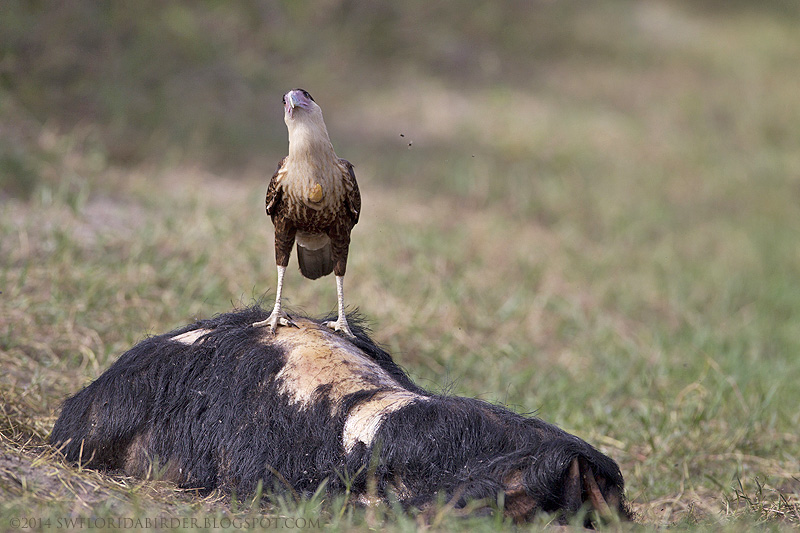
The Crested Caracara above (image 1) was photographed at Church Road in January 2015.
There should definitely be a concern for vehicular traffic on this road which travels at a high speed. Weekend days are best for minimal disturbance. If you are inclined to stop on the road, which you will, make sure to use care at all times.
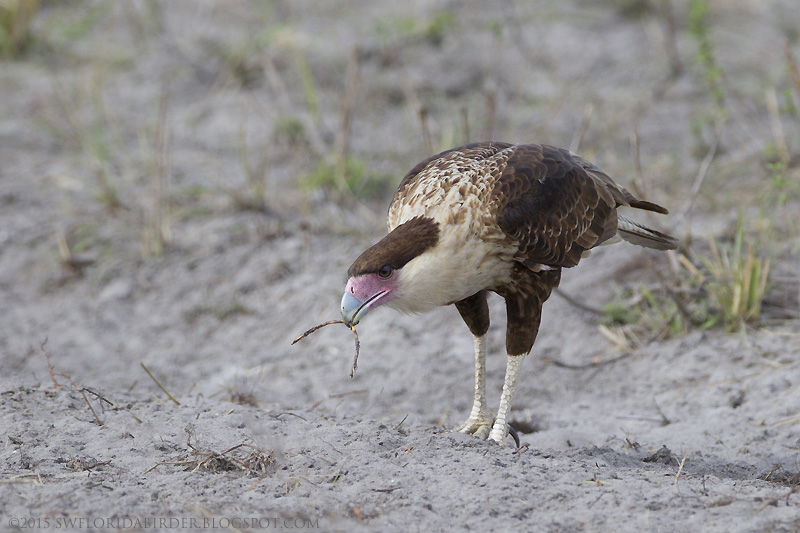
The Crested Caracara above (image 2) was photographed at Church Road in January 2015.
The Crested Caracara above (image 3) was photographed at Church Road in January 2015.
The Crested Caracara above (image 4) was photographed at Church Road in January 2015.
The Crested Caracara above (image 5) was photographed at Church Road in January 2015.
The Black Vulture above (image 6) was photographed at Church Road in January 2015.
This two-part article highlights the prolific Northern Crested Caracara which can be seen at Church Road ideally near sunrise or sunset. Many dozens of other species of bird and mammal shouldn't be overlooked including prolific butterflies and dragonflies.
The Black Vulture above (image 7) was photographed at Church Road in January 2015.
The Turkey Vulture above (image 8) was photographed at Church Road in January 2015.
The Western Kingbird above (image 9) was photographed at Church Road in January 2015.
The Great Southern White Butterfly above (image 10) was photographed at Church Road in January 2015.
The Crested Caracara above (image 11) was photographed at Church Road in January 2015.
I mention the caracara as Northern Crested Caracara for the first time here due to my research on the Florida subspecies which was learned to be a remnant of the last ice age that occurred about 10,500 BC. Crested Caracara could not escape their plight through migration since they don't engage in that behavior.
The Wood Stork above (image 12) was photographed at Church Road in January 2015.
The Wood Stork above (image 13) was photographed at Church Road in January 2015.
The Wood Stork above (image 14) was photographed at Church Road in January 2015.
The Wood Stork above (image 15) was photographed at Church Road in January 2015.
The Crested Caracara above (image 16) was photographed at Church Road in January 2015.
Caracara with a pink face indicate juveniles. It was noted by J. Lyons' Wildlife Rehabilitation (1984) that the face of Crested Caracara will be orange-red in color when the bird is at rest, though when under stress will change to a pumpkin color to yellow.
The Crested Caracara above (image 17) was photographed at Church Road in January 2015.
The Crested Caracara above (image 18) was photographed at Church Road in January 2015.
The Crested Caracara above (image 19) was photographed at Church Road in January 2015.
The Crested Caracara above (image 20) was photographed at Church Road in January 2015.
The Crested Caracara above (image 21) was photographed at Church Road in January 2015.
Caracara during breeding season will sport a bump on its breast in my observations at Church Road. I have not seen this characteristic reported anywhere in my research. It was determined that this occurs on the female while observing a copulation event.
The Crested Caracara above (image 22) was photographed at Church Road in January 2015.
The Crested Caracara above (image 23) was photographed at Church Road in January 2015.
The Crested Caracara above (image 24) was photographed at Church Road in January 2015.
The Crested Caracara above (image 25) was photographed at Church Road in January 2015.
The Crested Caracara above (image 26) was photographed at Church Road in January 2015.
This unusual anatomical characteristic of the caracara is missing from birding resources including the oiseaux-birds website. Their notation of the caracara's face changing color is otherwise interesting, though I have never seen this happen in real time.
The Crested Caracara above (image 27) was photographed at Church Road in January 2015.
The Crested Caracara above (image 28) was photographed at Church Road in January 2015.
The Crested Caracara above (image 29) was photographed at Church Road in January 2015.
The Crested Caracara above (image 30) was photographed at Church Road in January 2015.
The Crested Caracara above (image 31) was photographed at Church Road in January 2015.
The Northern Crested Caracara is noted to be a protected bird, though of "Least Concern." Caracara is a food source in southern parts of its range in a report from 2010. In this 2014/2015 season, there have been very good numbers of caracara observed.
The Crested Caracara above (image 32) was photographed at Church Road in January 2015.
The copulating Crested Caracara above (image 33) were photographed at Church Road in January 2015.
The Boat-tailed Grackle above (image 34) was photographed at Church Road in January 2015.
The Black Vulture above (image 35) was photographed at Church Road in January 2015.
The Black Vulture above (image 36) was photographed at Church Road in January 2015.
Copulation of the caracara observed during my 6 December visit to Church Road is considered early for the nesting season. This is an especially great time of year to make a trip to Church Road in Felda off of highway 82, just west of highway 29.
The Black Vulture above (image 37) was photographed at Church Road in January 2015.
Please also see Church Road Crested Caracara Overload: Part I
Showing posts with label copulation. Show all posts
Friday, February 6, 2015
Friday, February 26, 2010
Feature: Florida Burrowing Owl
On the eve of the 8th annual Burrowing Owl Festival in Cape Coral, Florida, I made my fifth attempt to observe and document the sub-species of Burrowing Owl that is thought to have in excess of 2500 nests in the city.
The Burrowing Owl above was photographed at the Cape Coral Library in February 2010.
I can't imagine a more fortuitous time to finally see the species and spend more than two hours observing its nest and what I would describe as an early riser (in the late afternoon).
All previous visits to Cape Coral with the hope to see the Burrowing Owl were met with failure.
The Burrowing Owl above was photographed at the Cape Coral Library in February 2010.
I had earlier considered stopping by Brian Piccolo Park, in Cooper City, Florida, while traveling through the Great Florida Birding Trail's Night-Heron Cluster to otherwise see the park's reliable nests and sightings of the owls.
Tim Rucci's sighting of the Burrowing Owl at Piccolo Park can be
seen here.
The Burrowing Owl above was photographed at the Cape Coral Library in February 2010.
Time constraints led to my postponing my attempted sighting of the owls on Florida's east coast with greater hopes of seeing the species closer to home on Cape Coral within the official nesting season which occurs 15 February through 10 July.
This species I would highly recommend you seek out when you have the chance as they are so photogenic or are simply fun to watch.
The Burrowing Owl above was photographed at the Cape Coral Library in February 2010.
The Burrowing Owl is very prevalent in Imperial Valley which is home to about 70 percent of California’s Burrowing Owl population.
When I encountered the owl that I considered much more diminutive than I had expected, I made an immediate planting of my presence to it.
The Burrowing Owl above was photographed at the Cape Coral Library in February 2010.
More than 90 minutes had passed before the mate of the bird I was observing emerged from the nest.
The bird first observed I consider to be the male based on my research of it for a couple of reasons.
The Burrowing Owl above was photographed at the Cape Coral Library in February 2010.
It is thought that the male spends more of its time outside of the nest and thus has a more "bleached" color to its feathers compared to the female otherwise very similar in appearance.
The female is slightly larger in size and therefore best distinguished when observing the mates together.
The Burrowing Owl above was photographed at the Cape Coral Library in February 2010.
I am quite sure that my first Burrowing Owl observed was the male as it was certainly smaller than the other that finally made its way out of the nest at sunset.
The action around the setting of the sun became a lot more exciting.
The Burrowing Owl above was photographed at the Cape Coral Library in February 2010.
Both feeding and copulation behavior were observed.
Although the nest observed is on a relatively lightly traveled side street adjacent to the library, the birds seemed to be alert to on occasional car passing or the bark of a dog.
The Burrowing Owl above was photographed at the Cape Coral Library in February 2010.
What I found even more interesting was that the birds seem to have extraordinary eyesight in their alertness to see what was flying overhead.
I was not able to react to the birds as quickly as I would have liked to capture some of the more entertaining postures of the creatures.
The Burrowing Owl above was photographed at the Cape Coral Library in February 2010.
As the light diminished and then seemed to disappear, the birds became the most active, and I'm quite sure I observed the birds mating if only so briefly for a few seconds.
It was near darkness when this activity occurred, so I was relying more on the camera to see than myself.
The Moon above was photographed at the Cape Coral Library in February 2010.
The shutter speeds were not very reliable for a focused shot in the end.
My preparation for this event included the reading of world renowned photographer Artie Morris's The Art of Bird Photography, where I was able to set the camera lens to its best performance capability.
The Burrowing Owl above was photographed at the Cape Coral Library in February 2010.
I knew I would have to leave the nest site at some time, but stayed until the lens would no longer focus on the action.
That was really late again, nearly 30 minutes after sunset, when I attempted to capture my last shots to present to you.
The Burrowing Owl above was photographed at the Cape Coral Library in February 2010.I can't imagine a more fortuitous time to finally see the species and spend more than two hours observing its nest and what I would describe as an early riser (in the late afternoon).
All previous visits to Cape Coral with the hope to see the Burrowing Owl were met with failure.
The Burrowing Owl above was photographed at the Cape Coral Library in February 2010.I had earlier considered stopping by Brian Piccolo Park, in Cooper City, Florida, while traveling through the Great Florida Birding Trail's Night-Heron Cluster to otherwise see the park's reliable nests and sightings of the owls.
Tim Rucci's sighting of the Burrowing Owl at Piccolo Park can be
seen here.
The Burrowing Owl above was photographed at the Cape Coral Library in February 2010.Time constraints led to my postponing my attempted sighting of the owls on Florida's east coast with greater hopes of seeing the species closer to home on Cape Coral within the official nesting season which occurs 15 February through 10 July.
This species I would highly recommend you seek out when you have the chance as they are so photogenic or are simply fun to watch.
The Burrowing Owl above was photographed at the Cape Coral Library in February 2010.The Burrowing Owl is very prevalent in Imperial Valley which is home to about 70 percent of California’s Burrowing Owl population.
When I encountered the owl that I considered much more diminutive than I had expected, I made an immediate planting of my presence to it.
The Burrowing Owl above was photographed at the Cape Coral Library in February 2010.More than 90 minutes had passed before the mate of the bird I was observing emerged from the nest.
The bird first observed I consider to be the male based on my research of it for a couple of reasons.
The Burrowing Owl above was photographed at the Cape Coral Library in February 2010.It is thought that the male spends more of its time outside of the nest and thus has a more "bleached" color to its feathers compared to the female otherwise very similar in appearance.
The female is slightly larger in size and therefore best distinguished when observing the mates together.
The Burrowing Owl above was photographed at the Cape Coral Library in February 2010.I am quite sure that my first Burrowing Owl observed was the male as it was certainly smaller than the other that finally made its way out of the nest at sunset.
The action around the setting of the sun became a lot more exciting.
The Burrowing Owl above was photographed at the Cape Coral Library in February 2010.Both feeding and copulation behavior were observed.
Although the nest observed is on a relatively lightly traveled side street adjacent to the library, the birds seemed to be alert to on occasional car passing or the bark of a dog.
The Burrowing Owl above was photographed at the Cape Coral Library in February 2010.What I found even more interesting was that the birds seem to have extraordinary eyesight in their alertness to see what was flying overhead.
I was not able to react to the birds as quickly as I would have liked to capture some of the more entertaining postures of the creatures.
The Burrowing Owl above was photographed at the Cape Coral Library in February 2010.As the light diminished and then seemed to disappear, the birds became the most active, and I'm quite sure I observed the birds mating if only so briefly for a few seconds.
It was near darkness when this activity occurred, so I was relying more on the camera to see than myself.
The Moon above was photographed at the Cape Coral Library in February 2010.The shutter speeds were not very reliable for a focused shot in the end.
My preparation for this event included the reading of world renowned photographer Artie Morris's The Art of Bird Photography, where I was able to set the camera lens to its best performance capability.
The Burrowing Owl above was photographed at the Cape Coral Library in February 2010.I knew I would have to leave the nest site at some time, but stayed until the lens would no longer focus on the action.
That was really late again, nearly 30 minutes after sunset, when I attempted to capture my last shots to present to you.
Subscribe to:
Posts (Atom)