Friday, April 22, 2011

Feature: Fort De Soto Park - Part I

I first visited Fort De Soto Park in the mid 1980's when living in Tampa at the time.

The Willet above was photographed at Fort De Soto Park in April 2011.

I didn't have the slightest interest in wildlife observation then, but I recall the Laughing Gull as a species seen.

Fort De Soto Park is comprised of five interconnected islands south of Tierra Verde, Florida.

The Ruddy Turnstone above was photographed at Fort De Soto Park in April 2011.

It is ripe with a multitude of activities that can be engaged in including sun bathing, swimming, shelling, boating, paddling, camping, bicycling, fishing, also offering self guided tours of the historical fort (closed for rehabilitation on this trip).

Fort De Soto was inhabited by Tocobaga Indians at the time of Spanish exploration of the area in the early 1500's.

The Great Blue Heron above was photographed at Fort De Soto Park in April 2011.

My three day trip to the park granted by my immediate supervisor, Mark Tvaroha, would initially offer the Laughing Gull as the most abundant species seen in the park.

Mark is always entertaining to talk to with the wealth of experience he's had "in the woods."

The Laughing Gull above was photographed at Fort De Soto Park in April 2011.

He most recently spoke of his inability to get lost in them even while once attempting to do so.

While I had planned to arrive at Fort De Soto at dawn, I chose to get a good night's rest instead of the two hours I would have otherwise had.

The Laughing Gull above was photographed at Fort De Soto Park in April 2011.

My first stop was the East Beach Turnaround where I was able to observe sandpipers, plovers, egrets, Willet, Ruddy Turnstone, a few Brown Pelican, and terns including a pair of Least Tern seen for the first time this season while hearing them on April 11 in Fort Myers.

This is the first season I feel comfortable identifying the sandpipers in particular which were very difficult for me to distinguish in the infancy of my observation of birds a few years ago.

The fisherman above was photographed at Fort De Soto Park in April 2011.

As I've observed many times before, a bird with a fresh catch will often flaunt its quarry in the presence of other species which has consequences that are often extremely interesting to watch.

A gull that had flown in with a fish may have been the same one that was offering the catch as a gesture for the right to mate less than ten minutes later.

The Short-billed Dowitcher above was photographed at Fort De Soto Park in April 2011.

Fellow visitors with their dogs put a damper on the ability to observe wildlife further at the East Beach turnaround.

I made a stop at the administrative building and spoke briefly with Mr. Dan to get permission to enter the Primitive Camping Area the next morning.

The Least Sandpiper above was photographed at Fort De Soto Park in April 2011.

Mr. Dan told me of the changes to the park due to tidal activity and storms over the years.

He also pointed out the stuffed Roseate Spoonbill that regrettably met its end by getting hit by a car.

The Black-bellied Plover above was photographed at Fort De Soto Park in April 2011.

I continued on to North Beach and luckily found a parking space adjacent to the northernmost lagoon.

The Cypress trees there offered no evidence of the anticipated migrant bird species, but I did immediately notice a pair of Mourning Doves seemingly taking refuge from the heavy foot traffic within the park.

The Mourning Dove above was photographed at Fort De Soto Park in April 2011.

Red-winged Blackbirds were extremely prolific throughout the park in my initial observations as well.

As I waded my way through the lagoon, I observed four Mallard Ducks flying to the south showing the last evidence of breeding colors in the adult male.

The Red-winged Blackbird above was photographed at Fort De Soto Park in April 2011.

The gulls were in great numbers here as well with many of them engaging in their reproductive rituals.

They would be very aggressive toward the half dozen feeding White Ibis as sunset approached.

The Mallard above was photographed at Fort De Soto Park in April 2011.

I was compelled to explore this area thoroughly as I had not visited it before.

My approach was to stay close to the mangrove lined edge of the lagoon in hopes of seeing or at least hearing new species of bird not observed before.

The Short-billed Dowitcher above was photographed at Fort De Soto Park in April 2011.

A Magnificent Frigatebird was seen at its predictably high altitude.

At the northwest end of the lagoon I saw man-made evidence of the breeding season with a nest protected by stakes and tape.

The Laughing Gull above was photographed at Fort De Soto Park in April 2011.

This protected area seemed to at the time benefit Wilson's Plover with a pair of them seen adjacent to it.

The plovers were seen very briefly before I started wading back through the lagoon.

The scene above above was photographed at Fort De Soto Park in April 2011.

A few photographers were seen in the distance to the east observing a pair of American Oystercatcher.

Black Skimmers appeared much later at the lagoon and made their trademark flyby while skimming the water as they headed in the direction of the gulf.

The Wilson's Plover above was photographed at Fort De Soto Park in April 2011.

Most other commonly seen wading and shore birds were observed at least briefly in and around the lagoon.

Although it wasn't planned, it was my great fortune to have a late day low tide that allowed me to observe the wildlife from within the north lagoon as birds were attracted to the ideal feeding conditions.

The scene above above was photographed at Fort De Soto Park in April 2011.

As I was photographing the birds as low to the water's surface as was comfortable while remaining mobile, the crabs often found me and nipped at my legs causing occasional distractions.

There were numerous passers by whom often wielded cameras that would document their wildlife sightings.
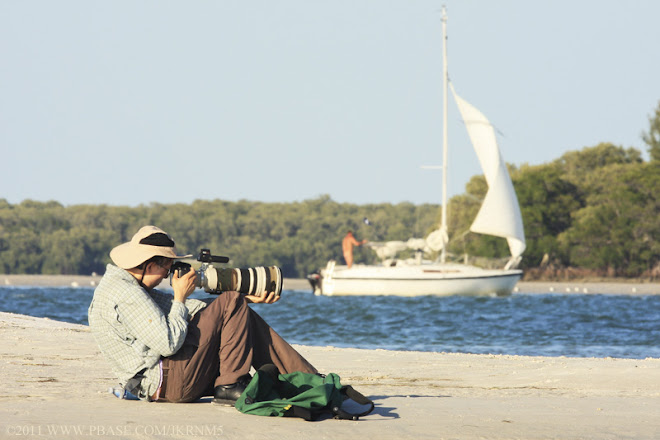
The scene above above was photographed at Fort De Soto Park in April 2011.

While the light of the day seemed to be rapidly diminishing, I made my way to my next vantage point which was just north of the Gulf Pier.

I was immediately captivated by a photographer in really good late day light though looking into it.

The Double-crested Cormorant above was photographed at Fort De Soto Park in April 2011.

My study of her and her subject lasted for a half dozen images with a favorite created among them in all the photographs that I've ever taken.

In the next seconds I would take an image of a couple when the man approached me to mention his disdain and that I should have asked his permission to photograph him.

The scene above above was photographed at Fort De Soto Park in April 2011.

He would introduce himself as Lee Hawkins and questioned me if I knew the name Ansel Adams while his wife Deb was capturing a video of the sunset.

The charitable endeavors of the Hawkins' were discussed briefly though certainly a major accomplishment for them.

The scene above above was photographed at Fort De Soto Park in April 2011.

Lee and Deb told me of one of their friends photographing scenery and wildlife in Alaska at the time of the 9-11 terrorist event and I immediately thought of my friend Tim Rucci whom was there at the time as well.

The full moon rising was quite impressive to observe after the sunset minutes before.

The sunset above was photographed at Fort De Soto Park in April 2011.

Feature: Fort De Soto Park Part II
Feature: Fort De Soto Park Part III

Friday, April 15, 2011

Wood Duck At Six Mile Cypress Preserve

It's approaching the peak for migratory birds making their way back to the place they will spend the summer, breed and rear their young.

The Anhinga above was photographed at Six Mile Cypress Slough Preserve in April 2011.

I had considered making a trip this week to a far away place (one of many) on the Great Florida Birding Trail known to offer a spectacle of this event.

There are a few wildlife venues that are known to be magnets for fallouts of migratory species.

The Carolina Wren above was photographed at Six Mile Cypress Slough Preserve in April 2011.

I have squandered opportunities to observe these migrants returning from the tropics in years past and have decided to make them a primary focus this year.

Six Mile Cypress Slough Preserve was chosen for its proximity to home and simply that it's one of the best wildlife destinations in the immediate Fort Myers area that I know of.

The spider web above was photographed at Six Mile Cypress Slough Preserve in April 2011.

I arrived at the preserve after the drive wondering why the snow birds have wanted to leave the area so prematurely with unfavorable weather still lingering up north.

The traffic on the local highways has been thinning quite substantially though Boston driving tactics are still seen daily and are to be very wary of.

The spider above was photographed at Six Mile Cypress Slough Preserve in April 2011.

There was no bird activity near the parking area of the preserve nor in the Cypress trees at the entrance to the boardwalk that I found unfortunate.

I chose to walk the boardwalk the "wrong way" and visited the photo blind at Pop Ash Pond first to find a solitary Anhinga drying itself after an early morning dip.

The Florida softshell turtle above was photographed at Six Mile Cypress Slough Preserve in April 2011.

At Otter Pond a few turtles were seen before I headed to my favorite observation spot at Six Mile Cypress which is Marker 19 near Wood Duck Pond.

A bird strafed a squirrel which I speculate might have been a Merlin that was a highlight of my time at Marker 19.

The Carolina Wren above was photographed at Six Mile Cypress Slough Preserve in April 2011.

I heard the Red-belied Woodpecker for an hour before it finally came into view high in the treetops.

The Carolina Wren was the most visible bird species on my visit to the park and offered better opportunities to photograph the species than I've had before.

The Wood Duck above was photographed at Six Mile Cypress Slough Preserve in April 2011.

With the lack of the expected photo ops at Marker 19, I moved on and was at the amphitheater on my way out of the preserve when I was asked by a fellow visitor if I had seen the Wood Ducks.

I was almost incredulous as it's a species I had never observed before which I had considered making an hours long drive to see in the past.

The Wood Duck above was photographed at Six Mile Cypress Slough Preserve in April 2011.

Needless to say, I was back into the preserve at the point that I was given directions to where the ducks had been seen, but no ducks.

It was at that point that I met Arne Haryn to learn that he had earlier seen the ducks as well.

The Wood Duck above was photographed at Six Mile Cypress Slough Preserve in April 2011.

He led me to the point he had seen them a few hundred feet south along the boardwalk where he again found the ducks practically under it.

It was a thrill for me to observe the Wood Ducks for about an hour as they worked their way around the ancient Cypress tree stumps in the preserve at Otter Pond.

The Wood Duck above was photographed at Six Mile Cypress Slough Preserve in April 2011.

The ducks were an apparent mated pair though no juveniles were present.

Another visitor noted his observation of a Water Moccasin seen closer to Wood Duck Pond.

Arne Haryn (at right) above was photographed at Six Mile Cypress Slough Preserve in April 2011.

Arne was very especially interested in that and led the way to the snake that was found in the area as described.

It was interesting to hear Arne tell of his visits to the slough decades ago before the boardwalk was constructed.

The Wood Duck above was photographed at Six Mile Cypress Slough Preserve in April 2011.

He told me that he was a scout for a wildlife photographer friend of his at that time.

An offspring of the snake was seen very well camouflaged with the adult after further observation by yet another visitor to the preserve.

The Water Moccasin above was photographed at Six Mile Cypress Slough Preserve in April 2011.

I wielded the camera hand held in an effort to capture the adult snake in an image unsuccessfully before Arne offered me use of his shoulder which was neat to get the angle needed, but couldn't find the snake because of my inability to keep the gear steady enough.

A "Hail Mary" was made as I climbed the rails of the boardwalk to get an even better view to find that the grace of modern technology in image stabilization allowed an in focus shot of the serpent.

The Carolina Wren above was photographed at Six Mile Cypress Slough Preserve in April 2011.

Back at Wood Duck Pond a third Wood Duck observed flew across the pond toward Marker 19 where I was sure I've seen the Wood Duck before while this species is not normally tolerant of spectators.

Exiting the preserve, Arne pointed out the egrets that were nesting across Gator Lake.

The dragonfly above was photographed at Six Mile Cypress Slough Preserve in April 2011.

Arne specializes in his observations of the micro world allowing people to look through his spotting scope honed in on a wildlife subject he has an interest in while noting that he often looks for a shadow on a leaf.

A follow up visit to Six Mile Cypress Preserve this week was made in an attempt to observe the Wood Duck again.

The Little Blue Heron juvenile above was photographed at Six Mile Cypress Slough Preserve in April 2011.

No luck there, but did see the Black-and-white Warbler that I had missed on my previous visit.

The Least Tern's arrival from South America was observed audibly on April 11th near my residence for the first time this year.

The Black-and-white Warbler above was photographed at Six Mile Cypress Slough Preserve in April 2011.

Friday, April 8, 2011

Estero Lagoon Locals

Very windy conditions on the Florida Gulf Coast were again experienced this week as a storm front passed over the Florida Peninsula offering much needed rain though very little accumulated in the Fort Myers area.

The Reddish Egret above was photographed at Estero Lagoon in April 2011.

The weather was otherwise ideal for an afternoon visit to Estero Lagoon early in the week.

I found haven from the wind by settling in the water exiting the lagoon into the gulf near a clump of mangroves on the beach.

The Osprey above was photographed at Estero Lagoon in April 2011.

From this position I was able to study a surprisingly docile Reddish Egret that was often wary of the beach patrons passing by.

I was able to observe a number of White Ibis, a Snowy Egret, and a Mottled Duck work the lagoon.

The Snowy Egret above was photographed at Estero Lagoon in April 2011.

A very rarely seen Herring Gull made a close flyby over the lagoon as it headed south along the beach.

An Osprey made a landing behind a dune in the lagoon and appeared back into view carrying a stick for nest building.

The Herring Gull above was photographed at Estero Lagoon in April 2011.

This was a treat to observe as I thought this activity had peaked a couple of months ago.

While it's been evident that snow birds (tourists) have been returning home these past couple of weeks, there still was a lot of foot traffic at the lagoon.

The Magnificent Frigatebird above was photographed at Estero Lagoon in April 2011.

A pair of visitors from Miami photographed the Reddish Egret with me for a brief time.

The Roseate Spoonbill failed to arrive on the scene as I commented was a possibility.

The Miamian above was photographed at Estero Lagoon in April 2011.

After walking a few hundred yards to the south, I settled down to study a pair of Snowy Egret and the Reddish Egret that had flown in to take advantage of the incoming tide.

A Ruddy Turnstone flew onto the scene for a brief moment as the sun was close to setting.

The Reddish Egret above was photographed at Estero Lagoon in April 2011.

I chose to photograph the waders directly into the sun in the final hour of my stay at the lagoon for what I had hoped would offer some interesting images.

This proved to be a problem with the reflection of the sun in the water so bright that I needed to use manual focus as auto focus couldn't distinguish the birds from the surf.

The Michiganian above was photographed at Estero Lagoon in April 2011.

The beach goers near Estero Lagoon are often visiting from other parts of the country or the world.

It's always interesting to speak with them when the chance arises.

The Snowy Egret above was photographed at Estero Lagoon in April 2011.

Friday, April 1, 2011

Bunche Beach Tornado Watch

A late in the week opportunity to capture some wildlife imagery was made to offer some fresh stuff.

The scene above was photographed at San Carlos Bay: Bunche Beach Preserve in March 2011.

The start of the morning was very gloomy with heavy winds yet the temperature was warm.

Without precipitation, although Lee County was reportedly under a Tornado Watch, I chose to travel to Bunche Beach knowing that the conditions would not be ideal.

The Reddish Egret above was photographed at San Carlos Bay: Bunche Beach Preserve in March 2011.

The night before I had received a reply from local birding enthusiast, Wes Dirks.

I thought I might meet up with him at the Sanibel Lighthouse, but the conditions were considered to be much too windy for photography of migrating passerines there.

The Snowy Egret above was photographed at San Carlos Bay: Bunche Beach Preserve in March 2011.

With the tide at Matanzas Pass still hours from its high upon my arrival at Bunche Beach Preserve, I had not seen the tide so high at the preserve before.

This was certainly due to the winds from the south that were driving the gulf waters into the bay.

The Dunlin above was photographed at San Carlos Bay: Bunche Beach Preserve in March 2011.

I chose to walk about a half mile to the east along the shoreline and wait for the birds.

The sighting of a Bald Eagle and Magnificent Frigatebird after immediately stepping out of the car I thought a good omen.

The scene above was photographed at San Carlos Bay: Bunche Beach Preserve in March 2011.

This was a very rare occasion when I would not wade in the water as the waves were fierce.

Although I wouldn't see the eagle again, two frigatebirds would fly toward me during my visit.

The Brown Pelican above was photographed at San Carlos Bay: Bunche Beach Preserve in March 2011.

A pair of Ospreys would make flyovers as well although the only species of bird I would see dive into the water apparently in search of food was a Royal Tern.

Many Snowy Egrets braved the conditions headed in the direction of Bird Island that would allow them good cover.

The Magnificent Frigatebird above was photographed at San Carlos Bay: Bunche Beach Preserve in March 2011.

Double-crested Cormorant and Brown Pelicans were prolific in flying toward the lighthouse across the bay.

Willet, Reddish Egret, Tricolored Heron, Dunlin, and Black-bellied Plovers were headed in the direction of Bowditch Point just north of Fort Myers Beach.

The 3rd graders above were photographed at San Carlos Bay: Bunche Beach Preserve in March 2011.

A large group of children arrived on the scene that I would learn were two classes of third graders that were to learn about the food chain within the mud flats at Bunche Beach Preserve.

The windy conditions were ideal for an apparently very well experienced Kitesurfer that did some amazing leaps from the waves.

The Royal Tern above was photographed at San Carlos Bay: Bunche Beach Preserve in March 2011.

It was a treat to again visit Bunche Beach with nearly two months having passed.

The storm front that was the cause of the tornado warning that was reported to expire at 1pm was extended to 8pm when I returned home.

The Kitesurfer above was photographed at San Carlos Bay: Bunche Beach Preserve in March 2011.

It wasn't until 8:20pm that lightning could be seen and a trace amount of rain fell.