Friday, August 19, 2011

Feature: Everglades Agricultural Area Part II

Upon the return home from my first trip to the Everglades Agricultural Area, images taken were immediately transferred to the computer.

The Great Egret with Roseate Spoonbill above was photographed at Everglades Agricultural Area in August 2011.

I had immense excitement to determine if I had captured any of my wildlife photographs successfully as I had to manually focus with the gear I was using at the time.

I learned that I don't ever want to be in the same predicament again.

The Cattle Egret above was photographed at Everglades Agricultural Area in August 2011.

The next day I returned to the agricultural area with my primary camera that would allow autofocus of images taken presented here.

It was a much more enjoyable experience and was more confident with the exposure control of this camera I had been using for the last six months or so.

The Green Heron above was photographed at Everglades Agricultural Area in August 2011.

Departure from home was again a few hours before optimal sunrise light.

Tom Obrock, Jose Padilla and Vince Lucas were on their way but traveled another route from the Naples area.

The Red-winged Blackbird above was photographed at Everglades Agricultural Area in August 2011.

I arrived at the first flooded field east of the University of Florida Agricultural Research and Education Center in predawn light and was surprised by the relative absence of birds seen in great numbers the morning before.

The birds may have been on the south end of the flooded field too far to see without the benefit of binoculars at the least.

The Mottled Duck above was photographed at Everglades Agricultural Area in August 2011.

I continued on to the Brown's Farm Road flooded fields.

They had earlier offered the rarities not expected to be seen on the southern Gulf Coast including Black Tern, Gull-billed Tern and other migrants which I had hopes of photographing with better results.

The Black Tern above was photographed at Everglades Agricultural Area in August 2011.

The sunrise was spectacular as I observed more wading birds than shorebirds.

I reported to Tom Obrock en route that I thought I had seen Fulvous Whistling-Duck, but found after review of the image taken that I had seen Black-bellied Whistling-Duck with the red color of the bill unmistakable.

The Black-crowned Night-Heron above was photographed at Everglades Agricultural Area in August 2011.

Hearing back from Tom that he had observed Barn Owl at "the tree" near the Miami canal, I wrapped up my observations on Brown's Farm Road to meet up with him, Jose and Vince at King Ranch on Highway 27.

I wasn't sure where King Ranch was, still unfamiliar with the area, but Tom got me headed in the right direction.

The Roseate Spoonbill with Wood Stork above was photographed at Everglades Agricultural Area in August 2011.

After driving past them, I would make a u-turn after a few miles when I was sure I was lost.

I found them east of the sugar mill as Jose and Vince had their digiscopes focused on Upland Sandpipers and a Killdeer that I recognized.

The American Avocet above was photographed at Everglades Agricultural Area in August 2011.

This observation point on the King Ranch frontage road along U.S. Route 27 about 2.5 miles south of County Road 827 is a good one especially with use of a digiscope.

Tom was gracious in allowing me use of his high powered binoculars to scan the sod fields.

The American Avocet above was photographed at Everglades Agricultural Area in August 2011.

We next stopped at the flooded fields east of the University of Florida Agricultural Research and Education Center which offered a plethora of bird activity that was in sharp contrast to my observation earlier in the morning.

There were perhaps a thousand birds including the especially entertaining Wilson's Phalarope.

The Black Tern above was photographed at Everglades Agricultural Area in August 2011.

Vince spoke of the value of setting up a blind here.

It was surprising to me to see so many shorebird species so far inland that are typically observed at the beach.

The Lesser Yellowlegs above was photographed at Everglades Agricultural Area in August 2011.

A shorebird blastoff event here was possibly caused by the shadow of a vulture flying overhead.

We then traveled to the Brown's Farm Road fields which I consider a favorite in the area visited thus far.

The shorebirds above were photographed at Everglades Agricultural Area in August 2011.

Roseate Spoonbill were again present in great numbers with several sporting well worn bands.

I recommended to Jose that we drive on the berm, warning of the rocks, and think he told me that it was a "rough road" after traversing it.
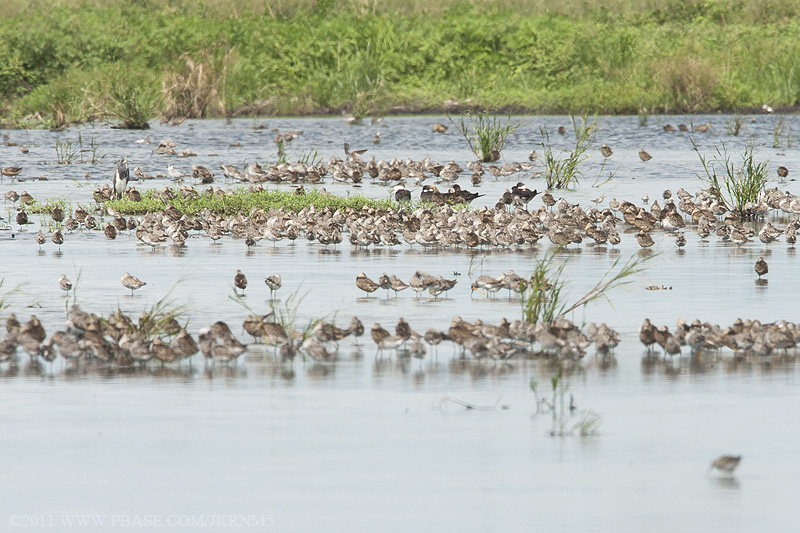
The shorebirds above were photographed at Everglades Agricultural Area in August 2011.

The berm offers a magnificent view of the fields to the east from its high elevation.

This berm should be driven on with great caution only if your vehicle offers high clearance.

The Roseate Spoonbill above was photographed at Everglades Agricultural Area in August 2011.

It was around noon at that point and the winds had really picked up with some drizzle.

From there we traveled north along the road I thought Tom Smith had told me wasn't worth traveling the day before.

The Pectoral Sandpiper above was photographed at Everglades Agricultural Area in August 2011.

We made our way back onto County Highway 880 after a rain storm passed us.

Access to Six Mile Bend Farm off of 880 and Brown's Farm Road was granted to us.

The Black-bellied Whistling-Duck above was photographed at Everglades Agricultural Area in August 2011.

This is another venue that requires a digiscope for best appreciation of the wildlife.

It offered an opportunity to get my first relatively good view of Upland Sandpiper which Vince said might accommodate my slow approach.

The birding masters (l to r) Jose Padilla, Vince Lucas and Tom Obrock above were photographed at Everglades Agricultural Area in August 2011.

While I was determined to get an image of the species directly in my path, I inadvertently flushed the other birds off to my left that I did not see.

This is the most skittish species of bird I have yet seen.

The Upland Sandpiper above was photographed at Everglades Agricultural Area in August 2011.

It was interesting to see the sod farm activities at this property.

We then traveled to Sam Senter Road which offered great bird activity in the early afternoon.

The Boat-tailed Grackle above was photographed at Everglades Agricultural Area in August 2011.

Jose allowed me use of a spare pair of binoculars he had for the remainder of our travels together.

The greatest concentration of Snowy Egrets were observed here with an observation of Fulvous Whistling-Duck which I last saw at STA5 in March.

The Glossy Ibis with Snowy Egret above was photographed at Everglades Agricultural Area in August 2011.

Our next stop on Gladeview Road south of 880 would offer another Fulvous Whistling-Duck with juvenile.

The weather again began to turn for the worse and we would part ways.

The Fulvous Whistling-Duck with juvenile above was photographed at Everglades Agricultural Area in August 2011.

On my drive home I would have my first sighting of Helmeted Guineafowl east of Palomino Drive on E State Road 80.

Tom Obrock has compiled a remarkable list of 73 species of bird on his trip this day with a great account that can be seen here.

The Helmeted Guineafowl above was photographed near the Everglades Agricultural Area in August 2011.

Press here for a map with locations of Everglades Agricultural Area wildlife venues visited in 2011.

Feature: Everglades Agricultural Area Part I
Feature: Everglades Agricultural Area Part III

Friday, August 12, 2011

Feature: Everglades Agricultural Area Part I

A view from above, very high above the southern peninsula of Florida offers quite a stunning view of the landscape.

The Common Nighthawk above was photographed at Everglades Agricultural Area in August 2011.

The most prominent landmark is Lake Okeechobee which has over time become a managed reservoir providing water for nearby urban areas and agriculture.

The Everglades Agricultural Area is primarily used for the growth of sugarcane.

The Semipalmated Sandpiper above was photographed at Everglades Agricultural Area in August 2011.

Crop production also yields citrus, vegetables, sweet corn and rice.

The fields create an interesting mosaic of shapes and colors not only as seen from above, but at ground level as well.

The Semipalmated Sandpiper above was photographed at Everglades Agricultural Area in August 2011.

Another interesting utilization of the land is the growth of sod which can be a magnet for certain species of birds.

Late summer here offers a glimpse of aves migration with countless birds on their way to South America, or to remain in Florida, for the winter.

The Wilson's Phalarope with Long-billed Dowitcher above was photographed at Everglades Agricultural Area in August 2011.

I would make my first visit to the area on 9 August 2011 with the intent of documenting my wildlife sightings through photography.

A 4:30am departure from Fort Myers led to my arrival at an extremely productive flooded field about a mile east of the University of Florida Agricultural Research and Education Center on County Highway 880 in Belle Glade, Palm Beach County.

The Black-necked Stilt above was photographed at Everglades Agricultural Area in August 2011.

I had prior to my arrival traveled parts of Duda Road which was misguided for finding the scores of birds in the area.

I made my first sighting of a Common Nighthawk slumbering on a powerline on Duda Road which led to the realization that I was not going to be able to use the autofocus feature of the camera.

The Black Tern above was photographed at Everglades Agricultural Area in August 2011.

Wrong camera to accompany a 2X extender which required me to manually focus all the images captured this day.

Manual focus is a skill that I didn't want to have a greater appreciation for on this trip.

The Black Tern above was photographed at Everglades Agricultural Area in August 2011.

It is challenging enough to capture birds in flight with autofocus.

I should have remembered this major fault with the 5dm2 as Tim Rucci had told me last year that the 2X extender would allow autofocus at the center point with my primary camera.

The Roseate Spoonbill above was photographed at Everglades Agricultural Area in August 2011.

My thinking was that I would need the megapixel capability of the 5dm2 anticipating heavy cropping of images of birds expected to be photographed from a great distance.

At the flooded field I met part-time wildlife observer and photographer Deputy Sheriff Thomas Smith visiting from the Boynton Beach area.

The Black-necked Stilt above was photographed at Everglades Agricultural Area in August 2011.

He told me he has been keeping a close eye on this area while I was quite surprised to find him where I did.

Tom was well camouflaged in vegetation on the berm that surrounds much of the field allowing him a very commanding view of the scene.

The Short-billed Dowitcher above was photographed at Everglades Agricultural Area in August 2011.

I must admit I was tempted to cross the channel between us, but did not want to test its depth.

There were countless Black-necked Stilts primarily between the two flooded fields I was viewing and the birds were typically vocal.

The Black-necked Stilt above was photographed at Everglades Agricultural Area in August 2011.

The highlight for me here was attempting to photograph my never before seen Black Tern.

A pair of American Avocet would fly in making them the first of season sighting for Tom and me.

The American Avocet above was photographed at Everglades Agricultural Area in August 2011.

Although I was certainly in no hurry to leave, Tom advised that I visit the flooded fields off Browns Farm Road (first bridge on left).

Upon arrival there I paused to observe the Roseate Spoonbill and Wood Stork that were in great numbers.

The Great Egret above was photographed at Everglades Agricultural Area in August 2011.

The birds were for the most part resting although became active when fish were periodically pumped into the field from the canal.

The wading birds seen here were in great contrast to the birds on the other side of the field primarily made up of shore birds.

The Roseate Spoonbill above was photographed at Everglades Agricultural Area in August 2011.

Another highlight was my first sighting of Gull-billed Tern which has the most appealing call of all the tern species I've heard.

Tom Smith arrived on the scene and allowed me a view through his scope.

The Gull-billed Tern above was photographed at Everglades Agricultural Area in August 2011.

The Black Tern was present in this area as well with what I believe might be my first observation of Curlew Sandpiper.

A drive over the berm at Browns Farm Road offered a very commanding view of the flooded fields.

The Stilt Sandpiper with Black and Gull-billed Tern above was photographed at Everglades Agricultural Area in August 2011.

High clearance is required here to avoid potential puncture of your vehicle's oil pan.

At noon time a rain storm made its way through the area and I chose to call it a day.

The Black Tern above was photographed at Everglades Agricultural Area in August 2011.

In all I'm not sure the total count of new species of bird I photographed this day and the next with day two highlighted in EAA Part II.

Thanks are due to Tom Obrock for writing about this wildlife area in his blog this past week which was the impetus for my devoting my two days off from work to investigate the agricultural fields which are ripe with migratory birds.

The scene above was photographed at Everglades Agricultural Area in August 2011.

Press here for a map with locations of Everglades Agricultural Area wildlife venues visited in 2011.

Feature: Everglades Agricultural Area Part II
Feature: Everglades Agricultural Area Part III

Sunday, August 7, 2011

Good Fishin' At Estero Lagoon

As I walked along the north lagoon at Little Estero Island Critical Wildlife Area this week, about a third as many Great Egrets were observed roosting in the mangroves than were seen a couple of weeks earlier.

The Least Tern above was photographed at Estero Lagoon in August 2011.

A wildlife enthusiast was photographing an accommodating Snowy Egret posing for her where the Lagoon empties into the Gulf of Mexico at low tide.

A lone Magnificent Frigatebird was seen flying over the condo towers almost immediately after my arrival, but disappeared from view and was not seen again.

The Sanderling above was photographed at Estero Lagoon in August 2011.

I returned to the south lagoon where a few dozen shorebirds were resting on a stretch of sand exposed as the tide receded.

Several of the species seen were bathing or preening themselves at one point or another.

The Least Sandpiper above was photographed at Estero Lagoon in August 2011.

A trio of Double-crested Cormorant were seen much closer on this visit and had their wings outstretched in typical fashion in an attempt to dry them.

While I was closely observing the shorebirds directly in front of me it was very evident that something had startled the cormorants.

The Double-crested Cormorant above was photographed at Estero Lagoon in August 2011.

In the next second an Osprey was seen flying directly in front of me with a very large fish in its talons.

My first photograph of it was in focus with the next have dozen no where close.

The Osprey above was photographed at Estero Lagoon in August 2011.

After again acquiring focus on the bird, it was passing in front of the buildings offering a less than favorable background in the images taken.

With the bird evidently struggling a second or two later, I finally got my best view of why the cormorants were concerned as I had my best view of the Osprey's prey.

The Osprey above was photographed at Estero Lagoon in August 2011.

The cormorants were not impressed and were in flight themselves in the next moment to find another place to end their day.

A tern observed with an unusual coloration in its bill and legs led to inquiries of the bird's identification.

The Double-crested Cormorant above was photographed at Estero Lagoon in August 2011.

The predominant opinion was that the bird seen was Sandwich Tern.

About half way through my stay a very young fisherman walked onto the scene and chose to walk right through the group of birds I was observing.

The Sandwich Tern above was photographed at Estero Lagoon in August 2011.

Some of the birds would return, but most did not.

As the light of the day began to fade, the sun was periodically seen through the cloud cover to the west.

The Brown Pelican above was photographed at Estero Lagoon in August 2011.

Since I rarely have the opportunity to photograph sunsets, I made an effort to capture a good image of this one.

Least Terns were much more active with the sun nearly on the horizon and I tried as well to photograph them successfully.

The Marbled Godwit above was photographed at Estero Lagoon in August 2011.

This required a much higher exposure bias to keep the birds out of silhouette with slower shutter speeds an undesirable result.

I currently try to avoid exceeding 800 ISO (digital equivalent) which I've noted maintains a reasonable degree of image quality in low light conditions.

The Ruddy Turnstone above was photographed at Estero Lagoon in August 2011.

It was exciting to see in review of images taken a Royal Tern that had a metal band which appears to be the type required by United States Geological Survey regulations.

The band was on the tern's right leg just above the foot.

The Least Tern above was photographed at Estero Lagoon in August 2011.

A close inspection of the band seems to indicate the number 56 from the angle of view I had.

This type of band is believed to have a unique series of numbers which would make identification of the bird from its previous handling assured.

The Laughing Gull above was photographed at Estero Lagoon in August 2011.

A problem here is that the engraving on this type band is extremely difficult to decipher in the field.

It has been noted that this type band is not intended to be interpreted from a distance.

The Wilson's Plover above was photographed at Estero Lagoon in August 2011.

Perhaps the greatest benefit of this type band is offering a better understanding of the longevity of the birds when they are found at the end of their life cycle.

Tom Obrock has encouraged me to routinely read Birdbrains while Vince Lucas has led me particularly here.

The Royal Tern above was photographed at Estero Lagoon in August 2011.

On my walk back to the car past the sand sculptures built that day, I was intrigued with the litter of bleached white trees and driftwood on the beach.

My thoughts immediately were to make an effort to rebuild the attraction that birds have frequently been perched on at the south end of the north Lagoon in past visits.

The Reddish Egret above was photographed at Estero Lagoon in August 2011.

Over time since my initial visit to the critical wildlife area, this hotspot to see a typical wading bird perched for a great photo-op has been lost due to weathering and tidal action.

Without much effort I carried a 15 foot tree to rebuild a perch for the benefit of a multitude of birds and possibly fish that will find shelter.

The scene above was photographed at Estero Lagoon in August 2011.

Upon each future visit to the Lagoon I will try to find another significant addition that should be a benefit to all.

I encourage you to do the same while having regard for the abundant wildlife in the Lagoon.

The sunset above was photographed at Estero Lagoon in August 2011.

In the image directly above, Sanibel Lighthouse can be seen at far left.